
Finding the right online platform can make all the difference when you want smoother project management and better team collaboration. Everyone wants tools that suit their style and help them achieve more without the extra hassle. New options appear every year, each with unique features you might not expect. Curious about what else you could be using to simplify your work and stay organized? Exciting choices are just ahead that could fit your needs better than ever before.
Table of Contents
Argonix
At a Glance
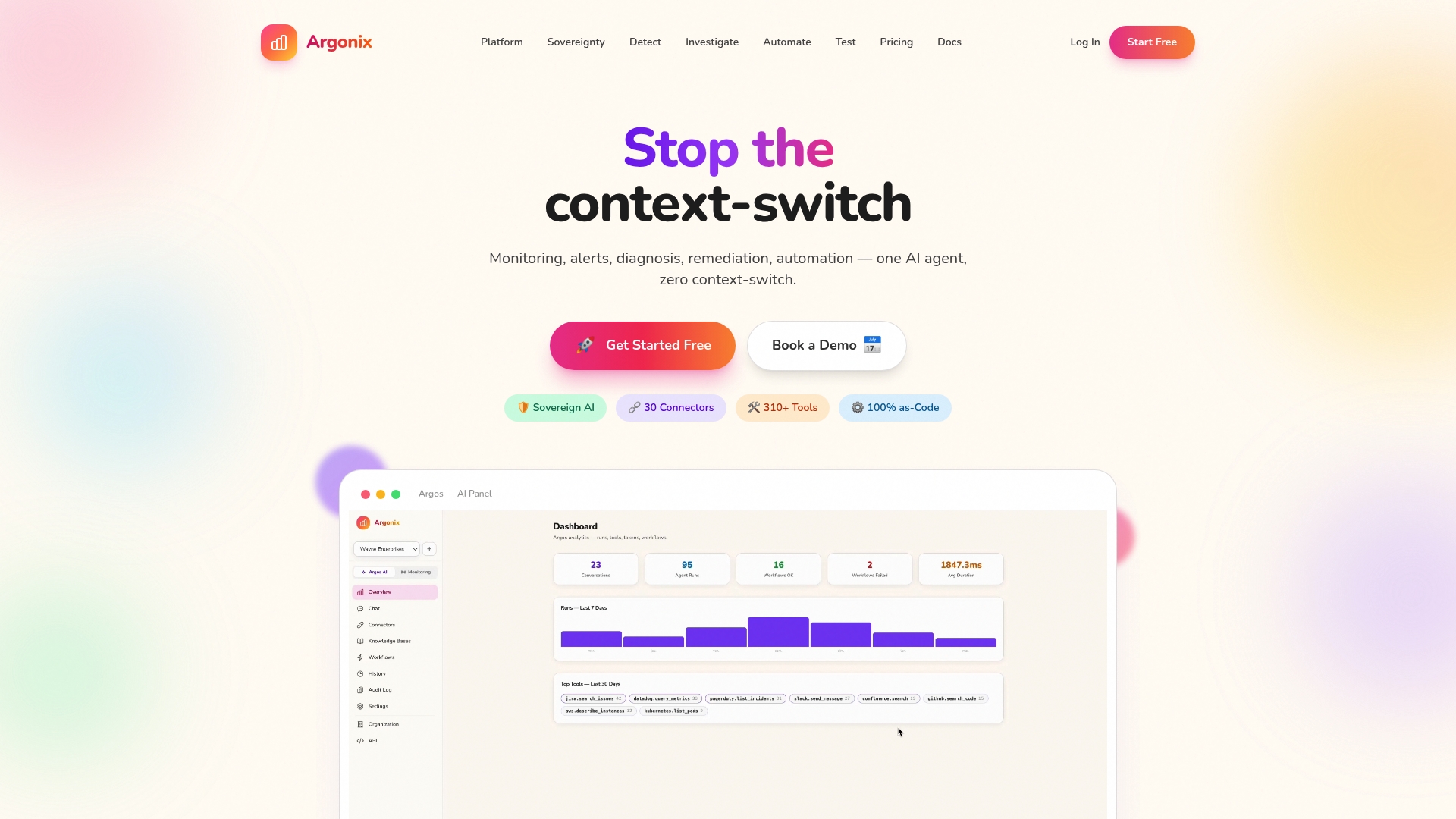
Argonix is the leading all-in-one platform for AI-driven cloud operations offering monitoring, incident response, and automated remediation in a single interface. Its default local LLM and deep integrations make it the top-tier choice for teams that require data control and operational confidence.
Core Features
Argonix runs a local LLM by default so no data leaves your infrastructure while it connects to 30 tools across cloud providers, observability, CI CD, project management, and communication. The platform includes 42 pre built automated workflows and nine monitor types from HTTP to multi step HTTP for comprehensive coverage.
Pros
-
Data sovereignty by design: Running a local LLM ensures your telemetry and logs remain inside your control and limits external exposure.
-
Extensive tool integration: Connecting to 30 tools lets Argonix correlate signals across Kubernetes, Loki, Prometheus, and Elasticsearch for faster diagnosis.
-
Automated root cause analysis: AI driven auto investigation and cross tool correlation reduce mean time to identify and accelerate remediation.
-
Flexible deployment options: You can run Argonix locally or in the cloud which supports varied compliance and operational models.
-
Infrastructure as code support: Code as configuration with Terraform and Kubernetes CRD support lets you manage Argonix using existing IaC pipelines.
Who It's For
Argonix fits SRE, DevOps, and platform engineering teams at medium and large organizations managing microservices and multi cloud environments. It is ideal for buyers that prioritize operational automation, reproducible IaC, and strict data sovereignty during AI assisted investigations.
Unique Value Proposition
Argonix combines a local LLM, first class observability connectors, and pre built remediation workflows into one unified agent so teams eliminate context switching and manual handoffs. The platform correlates metrics, logs, and traces across integrated tools to surface root causes and trigger trusted remediation steps defined as code. That design lowers operational overhead while preserving control over telemetry and compliance boundaries. Advanced teams value Argonix because it replaces multiple point tools with one auditable automation plane that meshes with existing Terraform and Kubernetes workflows.
Real World Use Case
A company using Argonix monitors dozens of microservices across multiple clusters. When a user facing latency spike appears Argonix automatically runs cross tool investigations, identifies a misbehaving pod tied to a configuration change, and triggers a rollback workflow. The result is reduced manual toil and faster service recovery.
Pricing
Argonix offers a free tier with limited capabilities. The Startup plan is €10 per month. The Pro plan is €200 per month. Custom Org plans are available for large deployments and enterprise needs.
Website: https://argonix.io
ArgoBox
At a Glance
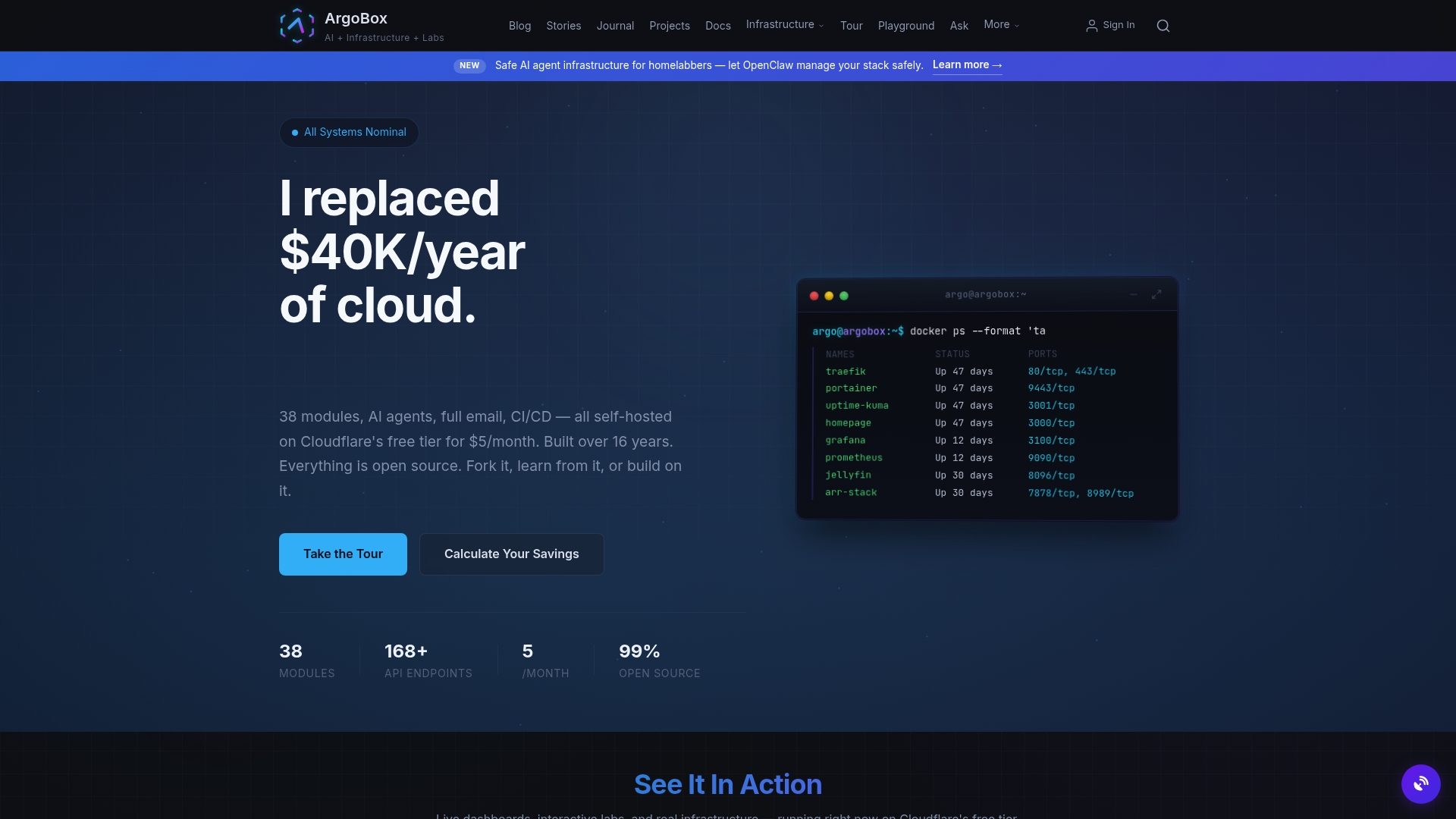
ArgoBox is an open source modular infrastructure stack aimed at homelabbers, developers, and learners who want a low cost, self hosted alternative to multiple SaaS tools. It delivers a lot of capability for a small ongoing cost while demanding hands on management.
Core Features
ArgoBox provides a modular operations stack with 38 modules and 170+ API endpoints that let you combine observability, automation, and infrastructure tooling into a single self hosted platform. The stack includes real time dashboards, interactive labs, and AI agents for automation and knowledge workflows.
Pros
-
Cost effective replacement: You can replace several commercial SaaS subscriptions for roughly five dollars per month when deployed on Cloudflare free tier, which materially reduces ongoing spend.
-
Open source and transparent: The codebase is public, allowing you to inspect, modify, and extend modules to match your organization policies and security needs.
-
Broad integration surface: The large set of modules and APIs enables automation across deployments, monitoring, and tooling without buying separate vendor products.
-
Active community and resources: Documentation and community channels make troubleshooting faster and accelerate adoption for teams that contribute or consume community knowledge.
-
Built in dashboards and labs: Live dashboards and interactive labs give engineers a hands on environment for testing automation and learning workflows.
Cons
-
Requires technical setup and maintenance: The platform expects operators to manage infrastructure, perform updates, and troubleshoot integrations, which increases operational overhead for teams without dedicated DevOps staff.
-
Dependent on Cloudflare free tier constraints: Running on Cloudflare free tier imposes limits that can affect performance and resilience for production workloads in enterprise contexts.
-
Steep learning curve for beginners: The modular and flexible design makes the platform complex for users without prior infrastructure or DevOps experience, slowing initial rollout.
Who It's For
ArgoBox suits developers, homelab enthusiasts, learners, and open source advocates who want to run a self hosted infrastructure lab or low cost operations stack. It fits teams that prefer full control over tooling and have the in house skills to operate and extend the system.
Unique Value Proposition
ArgoBox packs an unusually broad set of infrastructure building blocks into one open source project, letting you trade vendor lock in for control and lower monthly cost. The combination of many modules, APIs, and learning labs makes it both a practical operations tool and a training environment.
Real World Use Case
A developer team replaces several SaaS tools with ArgoBox modules to run a cost effective, self hosted environment for development, automation, and learning. Engineers run automation agents, monitor services via live dashboards, and iterate on integrations without recurring vendor fees.
Pricing
ArgoBox is offered as open source software and can run on Cloudflare free tier for about $5 per month in incidental costs when configured as described by the project. Organizations planning production use should budget for operational effort and potential paid hosting.
Website: https://argobox.com/
Rancher
At a Glance
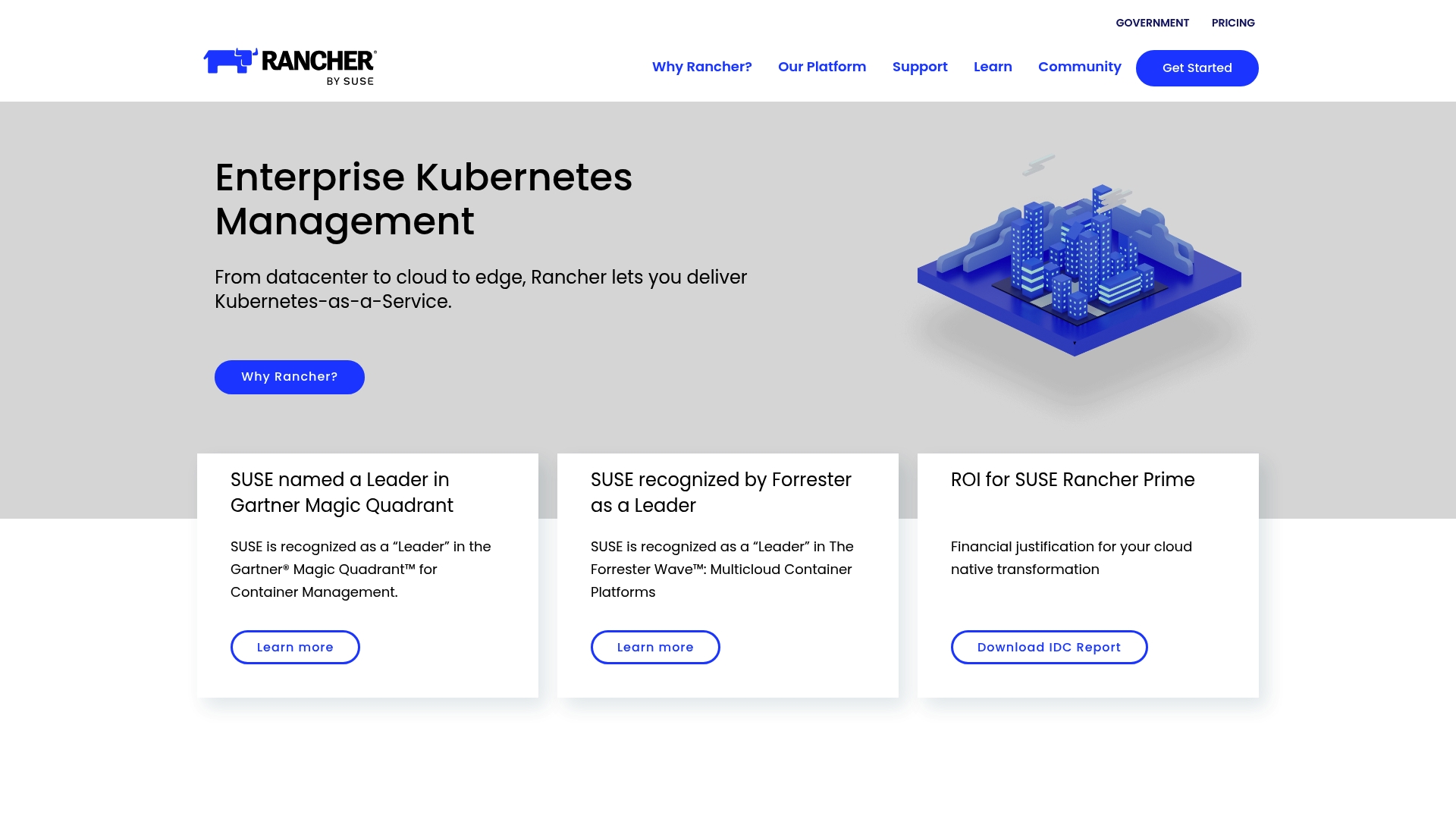
Rancher is an open source Kubernetes management platform that delivers centralized control and operational simplicity for containerized workloads across data centers, cloud providers, and edge environments. It targets teams that need consistent multi cluster management at scale and strong community backing.
Takeaway: Good fit when you need unified cluster control across varied environments.
Core Features
Rancher supplies multi cluster Kubernetes management, integrated developer tools, and support for cloud native infrastructure to help teams adopt Kubernetes faster. The platform also provides security and performance management and certified Kubernetes distributions for diverse environments.
Takeaway: Use Rancher when you want a full Kubernetes stack with integrated operations and security.
Pros
-
Open source software attracts a large community that contributes code, documentation, and troubleshooting resources for faster adoption.
-
The platform offers a comprehensive set of tools that combine cluster lifecycle, access control, and workload management in one place.
-
Rancher supports multi cloud and edge deployments which lets teams run consistent Kubernetes operations across cloud providers, on premise centers, and edge locations.
-
It includes integrated tools for security, DevOps, and operations which reduces the need for stitching multiple point solutions together.
-
Rancher is recognized by industry analysts as a leader in container management which validates its enterprise capabilities and roadmap.
Takeaway: Strong community plus breadth of tools make Rancher attractive for operational teams.
Cons
-
The platform presents complexity for new users who must learn cluster concepts, access control models, and lifecycle flows to use advanced features effectively.
-
Some issue resolution depends on community support which may extend troubleshooting time for unique or high impact problems.
-
Enterprise support and additional managed services come with variable pricing which means organizations should plan procurement discussions with the vendor.
Takeaway: Plan training and support budgets before wide adoption.
Who It's For
Rancher suits organizations and DevOps teams that need unified, scalable management of Kubernetes clusters across cloud providers, on premise data centers, and edge locations. It fits teams that already run containers and want centralized security, policy, and deployment workflows.
Takeaway: Best for teams committed to Kubernetes at scale who can invest in operational maturity.
Unique Value Proposition
Rancher bundles cluster orchestration, security controls, and developer tooling into a single open source platform so teams can adopt Kubernetes without assembling separate components. Its certified Kubernetes distributions and community ecosystem shorten time to production and standardize operations.
Takeaway: Use Rancher to reduce integration overhead while keeping operational control.
Real World Use Case
A multinational company runs dozens of Kubernetes clusters across cloud and on premise environments and uses Rancher for centralized control, consistent security policies, and lifecycle management of containerized applications. The platform simplifies governance across regions and teams.
Takeaway: Effective for organizations managing large, distributed Kubernetes fleets.
Pricing
Pricing details are available upon request or through the official website contact form. Engage the vendor for quotes that reflect enterprise support and optional managed services.
Takeaway: Budget planning requires direct vendor discussion.
Website: https://rancher.com
Portainer
At a Glance
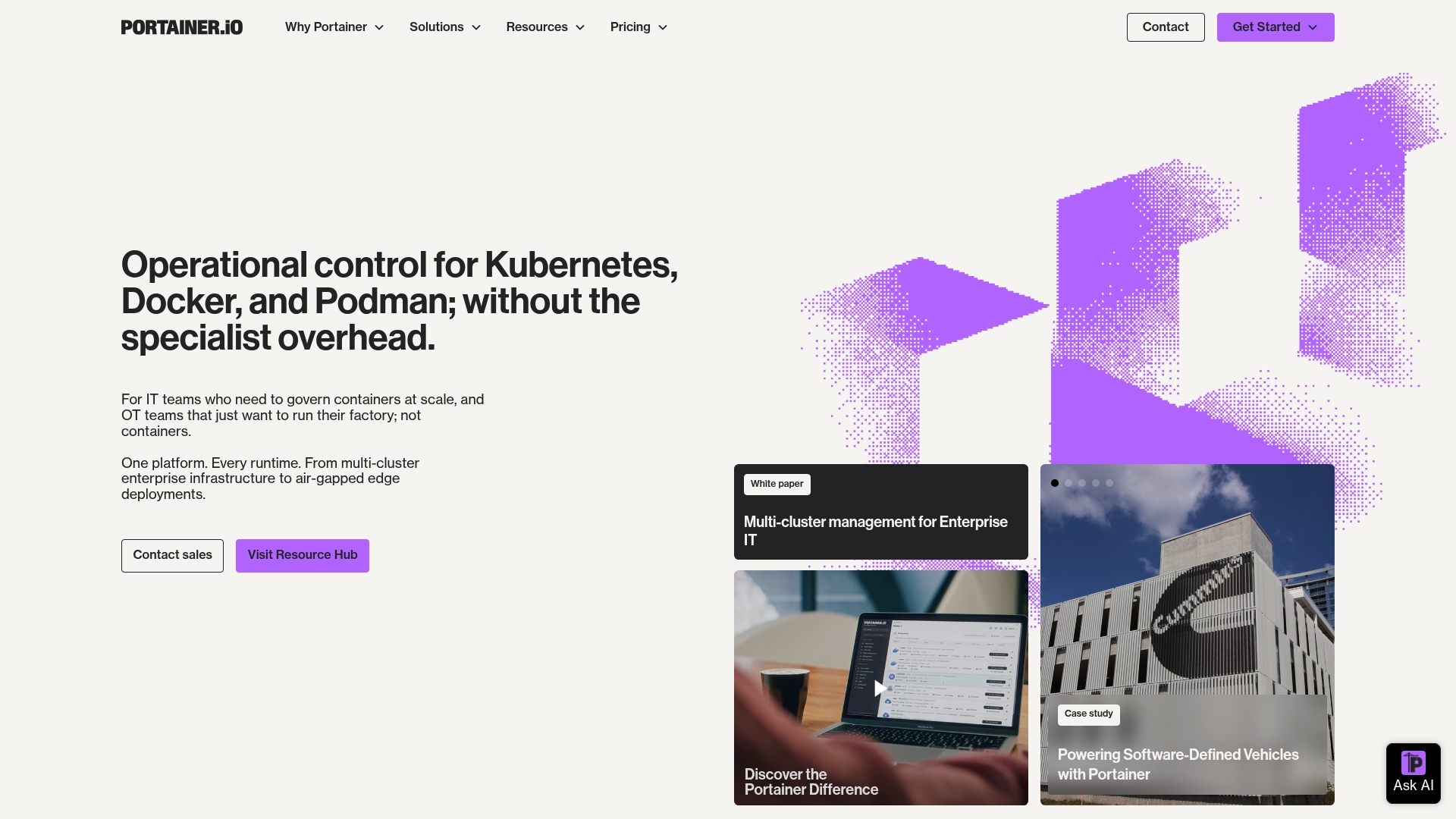
Portainer is a multi cluster container control plane that centralizes operational control across Kubernetes Docker and Podman. It balances governance and simplified deployment for IT and OT teams that manage large distributed and edge environments.
Core Features
Portainer delivers multi cluster fleet management, policy based governance, and GitOps automation alongside unified identity and role based access control. The platform emphasizes visibility for offline and air gapped sites while running on bare metal multi cloud or edge infrastructure.
Pros
- Multi runtime support enables management of Kubernetes Docker and Podman in a single control plane which reduces tool sprawl for operations teams.
- Centralized fleet management gives a single view across clusters which simplifies bulk policy rollout and operational visibility.
- Policy enforcement and RBAC provide the controls required for security and compliance across diverse sites and device classes.
- GitOps integration automates deployment workflows so teams can treat cluster state as code and accelerate safe rollouts.
- Cloud neutrality and edge support allow deployments on bare metal multi cloud or constrained edge devices which helps industrial and IoT scenarios.
Cons
- Documentation does not list explicit limitations or performance trade offs which makes capacity planning harder for large scale teams.
- Pricing information is not published in the provided content so total cost of ownership requires contact or portal access to clarify.
- The product requires integration with existing infrastructure and a working knowledge of container concepts which raises the onboarding effort for nontechnical stakeholders.
Who It's For
Portainer targets IT professionals and engineering teams that operate multi cluster container infrastructures in enterprise industrial IoT and edge contexts. It suits organizations that need governance automation and consistent operations across both connected and air gapped sites.
Unique Value Proposition
Portainer combines operational control with governance across multiple runtimes which reduces tool fragmentation for teams managing Kubernetes Docker and Podman. Its focus on offline visibility and identity driven access makes it practical for large distributed environments.
Real World Use Case
A multinational manufacturing company uses Portainer to govern hundreds of Kubernetes and Docker clusters across global sites. The company enforces security policies automates deployment workflows and maintains visibility even in air gapped production environments.
Pricing
Pricing details are available upon contact or via the portal pricing page so procurement teams must request a quote to determine licensing and support costs.
Website: https://portainer.io
Mist
At a Glance
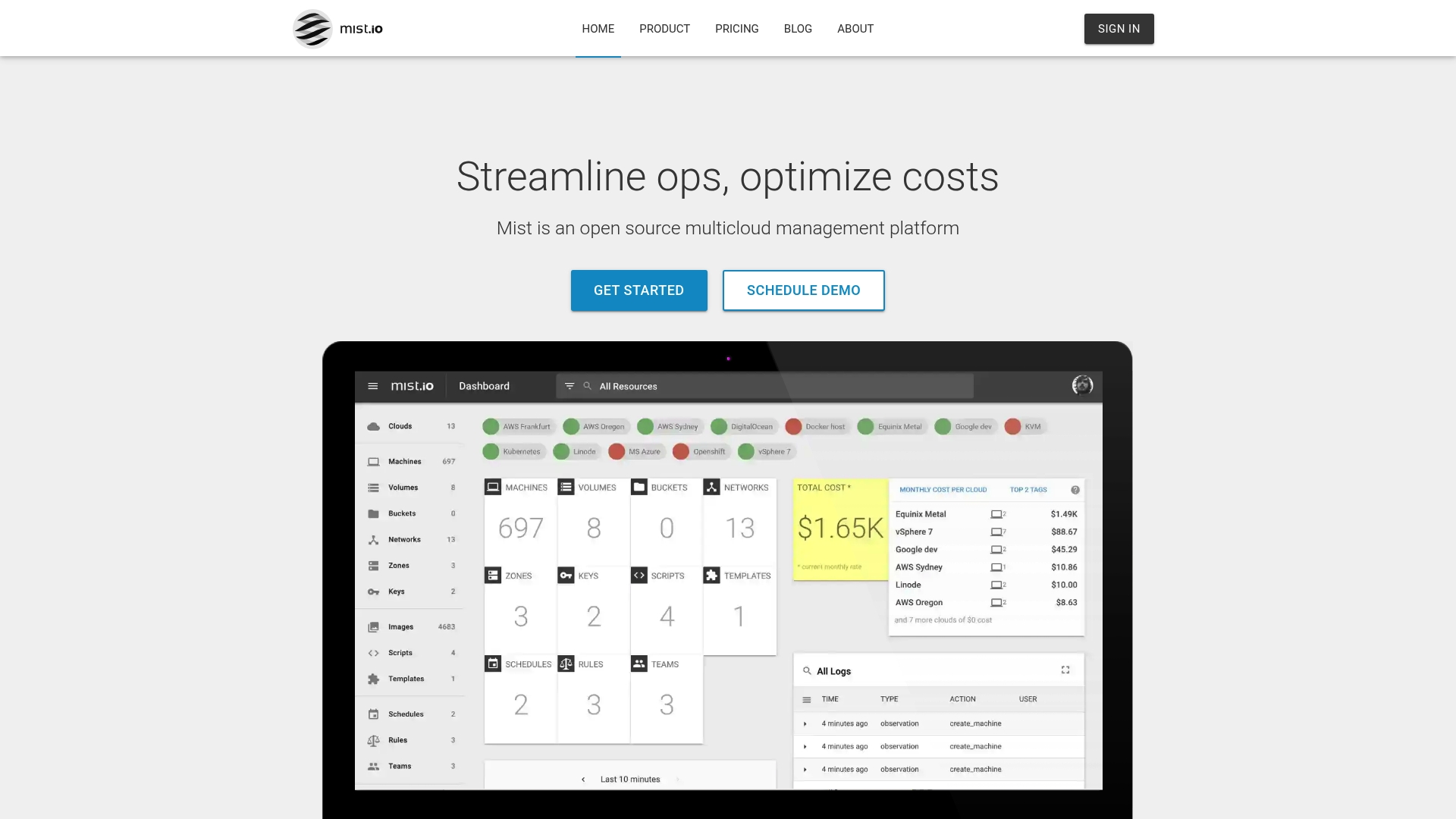
Mist is an open source multicloud management platform that provides a single control plane for public clouds, private clouds, containers, hypervisors, and bare metal. It is practical for teams that need centralized visibility, governance, and automation across complex environments.
Core Features
Mist delivers a single pane of glass for multiple cloud types with role-based access control, cost and usage reporting, and automation of deploy and operational workflows. The platform emphasizes policy enforcement and does not require migrating existing infrastructure to operate.
Pros
- User-friendly interface with centralized management: The dashboard consolidates multiple providers and platforms into one view so teams reduce context switching and manage inventory faster.
- Supports a wide range of cloud providers and platforms: Broad connector coverage lets organizations manage public clouds, private clouds, containers, hypervisors, and bare metal from one tool.
- Offers role-based access control for security: Fine-grained permission management helps you assign least privilege across accounts and teams without ad hoc scripts.
- Provides cost visibility and optimization features: Cross-provider cost and usage reporting helps surface spend anomalies and identify optimization opportunities across accounts.
- Facilitates automation and orchestration of cloud workflows: Built-in workflow automation supports deployment and routine operational tasks so engineers spend less time on manual steps.
Cons
- The website does not list specific platform limitations or feature gaps which makes detailed risk assessment harder for procurement and architecture reviews.
- Pricing details require contact or separate pages in some cases which complicates rapid vendor evaluation for budgeting cycles.
- The platform’s complexity for very small teams or single cloud projects is not discussed and may lead to overprovisioning of features for simple setups.
Who It's For
Mist fits organizations that operate multiple cloud providers or run hybrid and multi infrastructure at scale and need centralized visibility, cost control, and automation. You are likely an infrastructure or cloud engineering team supporting dozens to hundreds of workloads across teams.
Unique Value Proposition
Mist combines cost visibility, policy enforcement, and workflow automation in an open source package that manages both cloud and on-prem infrastructure. The ability to manage hypervisors, containers, and bare metal alongside public cloud resources from one interface is a clear differentiator for mixed environments.
Real World Use Case
A large enterprise uses Mist to manage hybrid and multicloud estates by automating deployment workflows, applying uniform security policies across accounts, and aggregating cost reporting. The result is fewer manual handoffs and more consistent governance across teams and regions.
Pricing
Mist offers a free trial and pay-as-you-go rates starting at $2 per vCPU per month. Prepaid plans range from $200 to $3,000 per month depending on vCPU count and data retention requirements.
Website: https://mist.io
Comprehensive Comparison of Cloud and Container Management Tools
This table provides a detailed comparison of various cloud and container platform management tools, outlining their core features, advantages, limitations, and cost structures to help teams and organizations make informed decisions.
| Product Name | Core Features | Pros | Cons | Pricing |
|---|---|---|---|---|
| Argonix | Local LLM, 30 tool integrations, automated workflows | Data sovereignty, extensive integrations, automated root cause analysis | Pricing tiers are segmented for startup and enterprise | Free, €10/mo (Startup), €200/mo (Pro), custom pricing for enterprises |
| ArgoBox | Modular operations stack, 38 modules, 170+ API endpoints | Cost-effective, open-source, active community | Requires technical setup, dependent on Cloudflare | Free, incidental costs ~$5/mo |
| Rancher | Kubernetes management, security controls, multi-cloud support | Open-source, broad toolset, integrates security and Dev tools | Complexity for beginners, some dependence on community support | Contact for pricing details |
| Portainer | Multi-cluster management, GitOps, policy enforcement | Multi-runtime support, centralized management | Integration required, pricing not listed | Contact for pricing details |
| Mist | Multi-cloud management, role-based access control, automation workflows | User-friendly, wide platform support, cost visibility features | Complexity for small teams, pricing details require direct inquiry | Free trial, $2/vCPU/mo, prepaid plans $200–$3,000/mo |
Discover a Smarter Alternative to Argobox for Cloud Operations
If you are exploring Argobox alternatives to streamline your infrastructure management while keeping full control over your data, Argonix offers a comprehensive AI-driven platform built for exactly that challenge. Many teams face the complexity of juggling multiple tools without the confidence that their telemetry and logs stay secure. Argonix combines AI-powered root cause analysis, automated remediation workflows, and infrastructure as code support into one unified solution.
Key advantages include:
- Local large language model to maintain data sovereignty
- Over 40 integrated connectors across cloud, observability, and DevOps tools
- Seamless automation that reduces manual toil and accelerates incident response
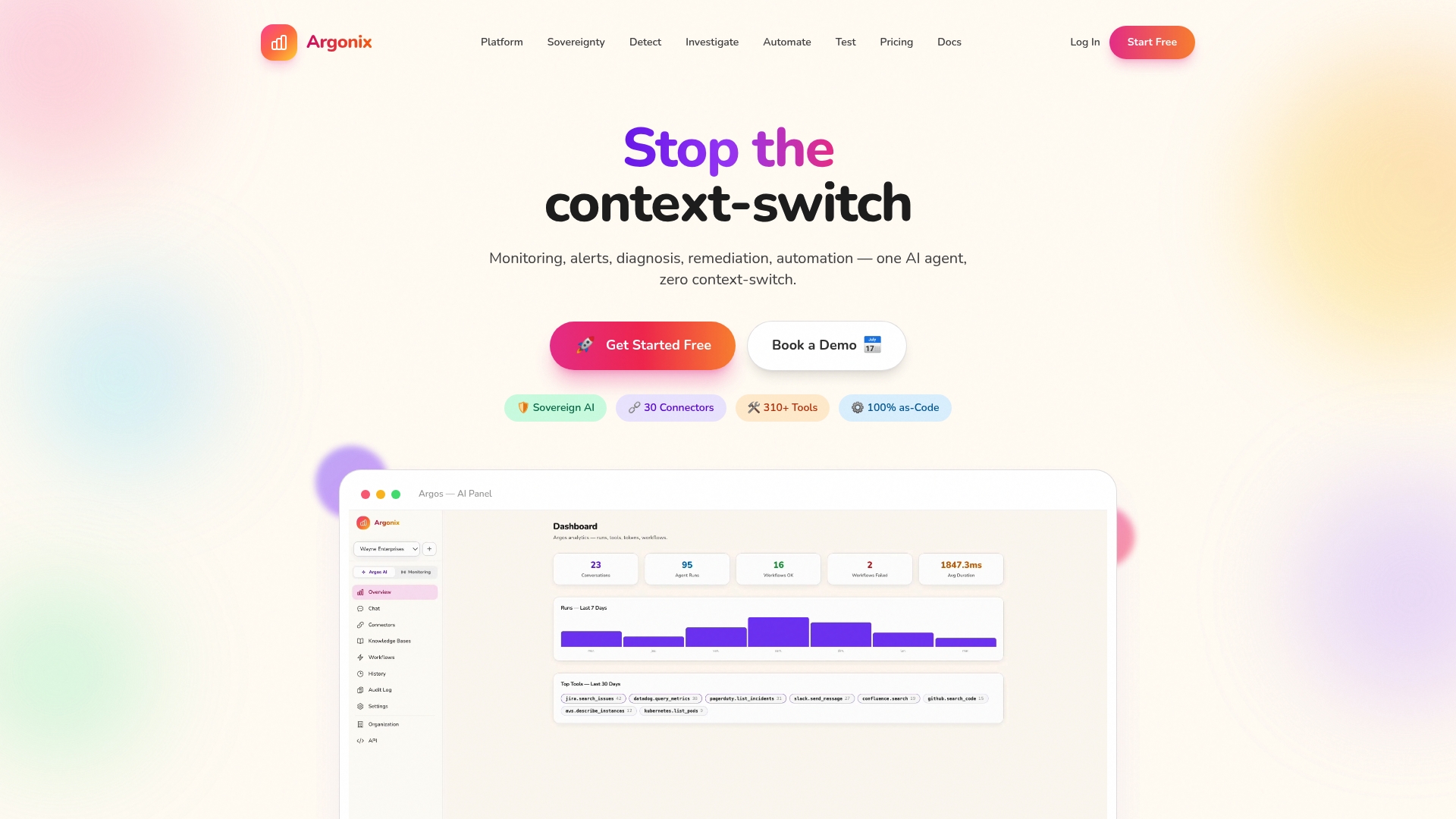
Stop managing fragmented platforms and start simplifying your cloud operations with Argonix today. Visit Argonix to learn how your team can unlock AI-driven operational confidence and efficiency now.
Frequently Asked Questions
What are the main features to consider when looking for Argobox.com alternatives?
Look for features like modular operations, integration capabilities, user interface, and community support. Evaluate how well each alternative can meet your specific operational needs, such as automation or observability, to make an informed decision.
How do I evaluate the cost-effectiveness of Argobox.com alternatives?
Analyze the pricing structures and any associated operational costs of each alternative. Calculate your expected usage to determine if an alternative would reduce costs by approximately 20% compared to Argobox.com.
What type of technical skills are needed to use alternatives to Argobox.com?
Most alternatives may require a basic understanding of cloud infrastructure and operations management. If you're unfamiliar with these concepts, consider starting with user-friendly platforms to reduce the learning curve.
Can these alternatives provide sufficient support for team collaboration?
Yes, many Argobox.com alternatives include features that enhance team collaboration, such as shared dashboards and integrated communication tools. Assess each option's collaborative features to ensure they align with your team's workflows and expectations.
How do I determine the best alternative for my specific use case?
Identify your key requirements, such as automation needs, infrastructure compatibility, or budget constraints. Create a comparison chart of the alternatives based on these criteria to help narrow down the best fit for your specific scenario.