

TL;DR:
- Most AI failures stem from ungoverned data leading to bias and errors.
- Effective AI data control involves policies, processes, and technical measures across the full lifecycle.
- Continuous automation and monitoring are essential for managing risks in autonomous AI systems.
Most AI failures don't start with bad code. They start with ungoverned data. A model trained on incomplete records, a pipeline missing a bias check, an audit trail that simply doesn't exist — these are the real culprits behind high-profile AI incidents. AI data control extends beyond traditional data governance to manage risks unique to AI such as model error amplification and algorithmic bias. For IT decision-makers running multi-cloud environments, understanding data control in AI isn't optional anymore. It's the foundation everything else is built on. This guide breaks down what it means, why it matters, and what you can actually do about it.
Table of Contents
- Data control in AI: Definition and core pillars
- From governance to active control: Policies, processes, and technology
- Risks and challenges: Security, compliance, and bias
- Best practices for implementing data control in AI
- Why data control must evolve for the agentic AI era
- How Argonix enables data control for secure AI operations
- Frequently asked questions
Key Takeaways
| Point | Details |
|---|---|
| AI data control essentials | Effective data control in AI extends traditional governance by managing quality, lineage, and bias across all lifecycle stages. |
| Active monitoring matters | Continuous monitoring and embedded policies are critical for preventing AI-related security and compliance incidents. |
| Prepare for agentic AI | Evolving your controls to support policy-embedded, provenance-rich data readies your organization for autonomous AI operations. |
| Best practice adoption | Embracing automated validation, testing, and synthetic data improves control, reduces risk, and supports compliance. |
Data control in AI: Definition and core pillars
Data control in AI is the set of policies, processes, and technical mechanisms that govern how data is handled at every stage of an AI system's life. It's not just about locking down a database. It's about maintaining integrity, fairness, and security from the moment data is collected to the moment a model's output influences a business decision.
Traditional data governance focuses on storage, access, and compliance for structured data. AI data control goes further. It has to account for how training data shapes model behavior, how errors compound through model layers, and how a single biased dataset can produce thousands of biased decisions at scale. Data control covers every lifecycle stage: collection, preparation, training, validation, deployment, and monitoring.
The six core pillars 📋
- Data quality: Completeness, accuracy, consistency, timeliness, relevance, and fairness
- Security: Access controls, encryption, and threat detection across the pipeline
- Lineage: Full traceability of where data came from and how it was transformed
- Bias mitigation: Active checks to detect and correct skewed training data
- Compliance: Alignment with regulations like GDPR, HIPAA, and emerging AI-specific laws
- Monitoring: Continuous oversight to catch drift, degradation, or policy violations
AI lifecycle stages vs. control requirements
| Lifecycle stage | Key control requirement |
|---|---|
| Collection | Consent, source validation, access logging |
| Preparation | Deduplication, bias screening, quality scoring |
| Training | Lineage tracking, version control, fairness testing |
| Validation | Accuracy benchmarks, adversarial testing |
| Deployment | Access policies, output monitoring, rate limiting |
| Monitoring | Drift detection, audit logs, anomaly alerts |
Organizations that skip formal AI data governance see significantly higher rates of compliance failures. The stakes aren't theoretical. A single audit failure tied to AI output can trigger regulatory investigations, fines, and reputational damage that takes years to recover from. Getting the pillars right from the start is how you avoid that scenario entirely.

From governance to active control: Policies, processes, and technology
Now that you understand the core concepts, let's look at how these principles move from theory into daily operational control.
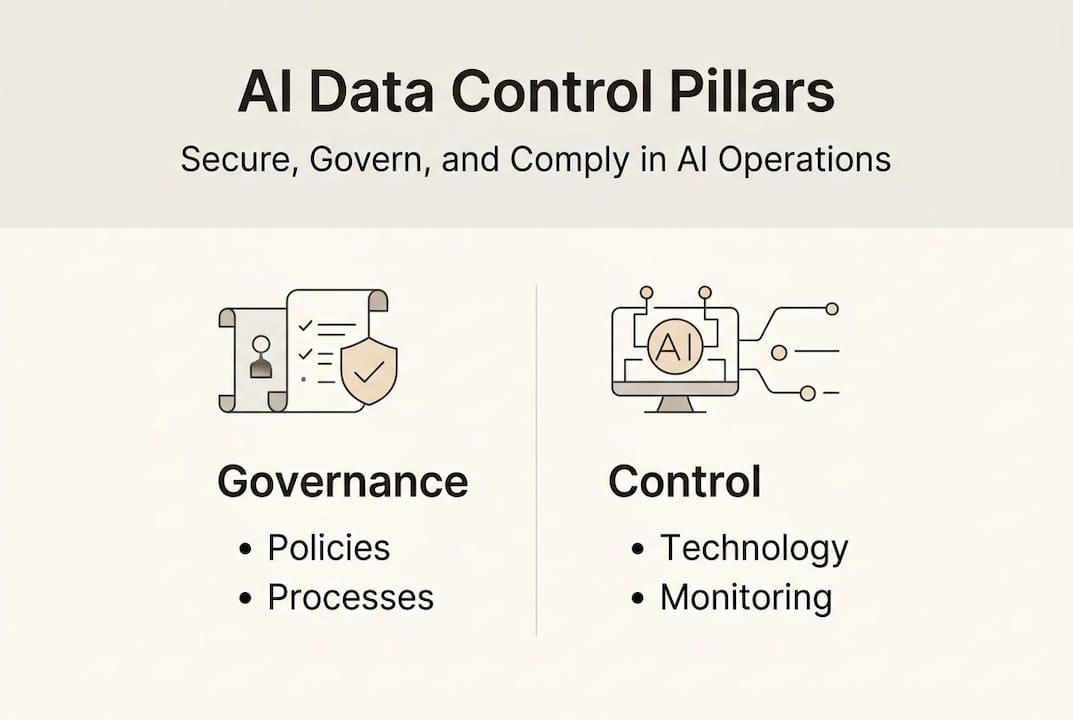
Setting a policy document is not data control. It's the starting point. Real control means those policies are enforced automatically, monitored continuously, and updated as your AI systems evolve. Embedding security and compliance checks at every stage, not just the start, is what separates active control from passive governance.
Passive governance vs. active control 🔄
| Approach | Passive governance | Active control |
|---|---|---|
| Policy enforcement | Manual reviews | Automated checkpoints |
| Compliance checks | Periodic audits | Continuous monitoring |
| Bias detection | Post-deployment review | Pre-training screening |
| Incident response | Reactive | Proactive with alerts |
| Data lineage | Documented manually | Auto-tracked in pipelines |
Here's how to move from passive to active in practice:
- Define your data policies: Document rules for data quality, access, retention, and bias thresholds before any model training begins.
- Embed policies in workflows: Use orchestration tools to enforce checks automatically at ingestion, transformation, and output stages.
- Automate validation gates: Build quality and compliance gates that block data from moving forward if it fails defined criteria.
- Monitor continuously: Set up real-time dashboards and alerts for data drift, access anomalies, and policy violations.
- Remediate fast: Define escalation paths and automated responses for when violations are detected.
One emerging idea worth knowing: "data that fights back." This means building provenance-rich, policy-embedded data objects that carry their own rules. When a downstream system tries to use that data in a way that violates policy, the data itself can trigger an alert or block the action. Think of it as moving control closer to the data rather than relying entirely on perimeter defenses. Understanding how AI agents and control policies interact is key to making this work in practice.
Pro Tip: Define and automate critical checkpoints for quality, bias, and compliance using orchestration tools. Manual reviews at scale are a liability. Automation turns your policies into enforceable reality.
Risks and challenges: Security, compliance, and bias
With clear policies and embedded technology, what risks demand constant vigilance in AI operations?
The risk profile for AI systems is genuinely different from traditional IT. Errors don't just sit in a database. They propagate. A biased training dataset doesn't produce one bad output. It produces millions. AI can amplify underlying data errors and hidden biases, with serious compliance and security implications.
Top risks in AI data environments 😱
- Unauthorized data access: Sensitive training data accessed by unauthorized users or systems
- Model drift: Production models diverging from validated behavior over time
- Bias amplification: Small skews in training data producing systematically unfair outputs
- Audit trail gaps: Missing lineage data making compliance documentation impossible
- LLM honesty failures: Models providing inaccurate or manipulated outputs under pressure
- Data poisoning: Malicious actors injecting corrupted data into training pipelines
Consider a real scenario. Your team trains a credit risk model on historical loan data. That data reflects past lending bias. The model learns the bias. It deploys. Thousands of decisions later, a regulator flags a pattern. You have no lineage records showing where the training data came from or what bias checks were run. That's not a code problem. That's a data control failure.
On the LLM side, models often remain honest in neutral settings but can be pressured to produce inaccurate outputs, making honesty-specific evaluation a critical part of your monitoring stack. This is an underappreciated risk. Most teams monitor for accuracy. Very few monitor for honesty under adversarial conditions.
Your data sovereignty safeguards need to account for both. Accuracy tells you if the model is right. Honesty tells you if it's being manipulated.
Pro Tip: Build monitoring for both accuracy and honesty metrics. Accuracy catches degradation. Honesty catches manipulation. You need both to run AI safely at scale.
Best practices for implementing data control in AI
Knowing the risks, here's how IT leaders can operationalize effective data control.
This isn't about adding more bureaucracy. It's about building control into your existing workflows so it runs without friction. Lifecycle-wide policies and continuous monitoring provide the foundation for effective AI risk management.
Implementation checklist ✅
- Run a full data inventory: Know what data you have, where it lives, who can access it, and what models use it.
- Design tiered access policies: Not everyone needs access to raw training data. Enforce least-privilege across all environments.
- Automate validation at ingestion: Use schema validation, quality scoring, and bias screening before data enters any pipeline.
- Implement lineage tracking: Every transformation, every model version, every data source should be logged automatically.
- Set up continuous monitoring: Track data drift, model performance, access logs, and compliance metrics in real time.
- Build a response plan: Define what happens when a violation is detected. Automated remediation where possible, human escalation where needed.
Data control tools and capabilities
| Capability | What it does | Why it matters |
|---|---|---|
| Access controls | Restricts who can read, write, or modify data | Prevents unauthorized use and data leaks |
| Lineage tracking | Records data origin and transformations | Enables audit trails and root cause analysis |
| Automated testing | Runs quality and bias checks continuously | Catches issues before they reach production |
| Drift detection | Monitors model behavior over time | Flags when retraining is needed |
| Policy enforcement | Blocks non-compliant data flows | Reduces manual oversight burden |
For multi-cloud environments, cross-team collaboration is non-negotiable. Your data engineering, security, compliance, and ML teams need shared visibility and shared tooling. Siloed control is no control at all. Explore testable controls and integrated AI Ops features to see how unified platforms reduce that coordination overhead significantly.
Pro Tip: Use synthetic data and test automation to assess bias and security controls without exposing sensitive information. It's one of the fastest ways to stress-test your controls before a real incident does it for you.
Why data control must evolve for the agentic AI era
Here's the uncomfortable truth most governance frameworks aren't built for: static policies don't work when your AI is making autonomous decisions in real time.
Most IT leaders still think of data control as a governance layer you configure once and revisit quarterly. That model made sense for traditional software. It doesn't hold up when you're running AI agents that ingest live data, make decisions, and trigger downstream actions without human review at every step.
The future of data control is provenance-rich, policy-embedded data objects that actively enforce rules as they move through agentic pipelines. This isn't a distant concept. It's becoming a practical requirement as organizations scale autonomous AI operations.
What does this mean for your team? You need to push beyond perimeter defense. Assume your agents will encounter data from untrusted sources. Assume policies will be tested by edge cases your governance team never anticipated. Build controls that travel with the data, not just around it.
The impact of autonomous AI agents on data control requirements is already being felt by teams running complex multi-cloud operations. Those who adapt now build compounding advantages. Those who don't face compounding risk as automation scales.
How Argonix enables data control for secure AI operations
Implementing data control at scale often means choosing tooling built for tomorrow's AI realities.
Argonix was built for exactly this environment. It gives your team active controls, not passive checklists.
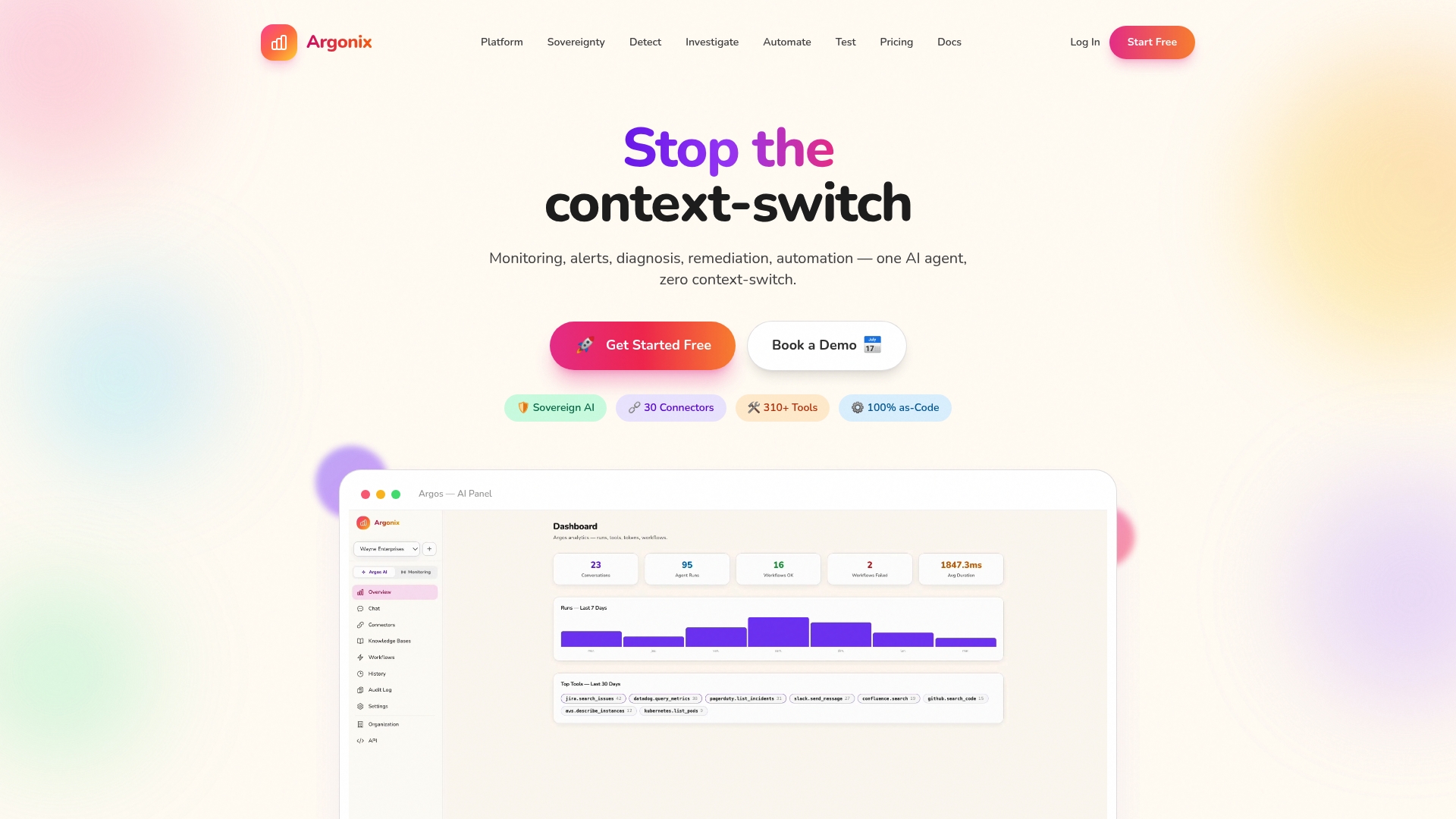
With Argonix, you get real-time infrastructure monitoring that tracks data flows, anomalies, and policy violations across your entire multi-cloud stack. When something goes wrong, AI incident response kicks in automatically, with root cause analysis and remediation workflows that don't wait for a human to notice the alert. And with GitOps automation, your control policies are version-controlled, auditable, and deployed consistently across every environment. If you're serious about operationalizing data control, Argonix gives you the platform to do it without building everything from scratch.
Frequently asked questions
What are the main components of data control in AI?
The main components are policies, processes, and technical controls that ensure data quality, security, lineage, bias reduction, and compliance across every stage of the AI lifecycle.
How does data control in AI help with regulatory compliance?
It provides traceability and continuous monitoring so your team can detect, prevent, and document compliance issues tied to AI data before they become audit failures.
What new risks does AI introduce compared to traditional IT?
AI systems can amplify small errors and biases, turning minor data quality issues into large-scale security failures, biased decisions, or regulatory breaches.
How do leading organizations operationalize data control in AI?
They automate validation checks, embed policies directly into data workflows, and use continuous monitoring tools to manage risk in real time rather than relying on periodic manual reviews.
Recommended
- Argonix | AI Ops Copilot - Monitoring, Incident Response & Infrastructure Automation
- Argonix | AI Ops Copilot - Monitoring, Incident Response & Infrastructure Automation
- Argonix | AI Ops Copilot - Monitoring, Incident Response & Infrastructure Automation
- Argonix | AI Ops Copilot - Monitoring, Incident Response & Infrastructure Automation