

TL;DR:
- Most cloud ops teams still rely on manual automation despite its critical role in operations.
- AI-native, multiagent platforms and orchestration are essential for scalable, cross-cloud automation in 2026.
- Embedding security, observability, and continuous ROI tracking into automation pipelines is vital for sustained success.
Multi-cloud automation is no longer a nice-to-have. It's the operational backbone your team either has or scrambles without. Yet only 23% integrate automation into service delivery, which means most cloud ops teams are still flying manual in environments that demand machine speed. That gap is both a warning and an opportunity. This article walks you through the criteria to evaluate automation solutions, four actionable best practices, and a realistic framework for turning scattered scripts into a resilient, scalable cloud ops engine in 2026.
Table of Contents
- Set clear automation criteria for 2026
- Best practice #1: Adopt AI-native and multiagent platforms
- Best practice #2: Prioritize orchestration and service delivery integration
- Best practice #3: Embed security and observability into automation pipelines
- Best practice #4: Operationalize continuous improvement and ROI tracking
- Why the real automation gains in 2026 hinge on orchestration and people
- Accelerate your automation journey with Argonix
- Frequently asked questions
Key Takeaways
| Point | Details |
|---|---|
| Set clear criteria | Defining business-aligned automation criteria is foundational for any decision in 2026. |
| Adopt AI-native platforms | AI-native and multiagent tools deliver speed and reliability for cloud operations. |
| Integrate orchestration | Orchestration, not just isolated automation, is key to scalable service delivery. |
| Build in security | Embedding security and observability into pipelines ensures resilient operations. |
| Prioritize continuous review | Continuous improvement and ROI tracking keep automation strategies effective. |
Set clear automation criteria for 2026
Before you evaluate a single tool, you need a clear scorecard. Picking automation platforms without defined criteria is like hiring engineers without a job description. You end up with mismatched tools, frustrated teams, and technical debt that compounds fast.
Gartner emphasizes AI-native platforms, multiagent systems, and orchestration tools as the defining trends for 2026. That signals a clear shift: generic automation scripts and bolt-on integrations are losing ground to purpose-built, intelligent platforms. Your evaluation criteria should reflect that shift.
Here are the top criteria to apply when assessing automation solutions:
- AI-native capability: Does the platform use AI for root cause analysis, anomaly detection, and decision-making, not just rule-based triggers?
- Multi-cloud compatibility: Can it operate across AWS, GCP, Azure, and hybrid environments without requiring separate configurations for each?
- Orchestration depth: Does it coordinate workflows across teams, tools, and cloud boundaries, or just automate isolated tasks?
- Security and compliance coverage: Are security checks embedded in automation pipelines, or are they an afterthought?
- Observability integration: Can it connect with your existing monitoring stack, from Prometheus to Datadog?
- Total cost of ownership: Factor in licensing, integration effort, and ongoing maintenance, not just sticker price.
For teams evaluating AI automation, the biggest mistake is optimizing for features over fit. A platform with 200 integrations means nothing if your team can't operationalize it. Also, scaling automation in SaaS environments shows that adoption speed and team enablement matter as much as raw capability.
Pro Tip: Align your automation KPIs directly with business resilience metrics like mean time to recovery (MTTR), uptime SLAs, and deployment frequency. If your automation doesn't move those numbers, it's not delivering real value.
Best practice #1: Adopt AI-native and multiagent platforms
With your criteria set, the next question is: what actually works at scale? The answer, consistently, is AI-native platforms with multiagent architectures. These aren't buzzwords. They represent a fundamentally different approach to cloud ops.
Traditional automation reacts. AI-native platforms predict, correlate, and act. They connect signals from logs, metrics, and traces to surface root causes before your on-call engineer even sees a PagerDuty alert.
Here's how to integrate multiagent tools effectively in hybrid and multi-cloud environments:
- Map your incident surface: Identify where most incidents originate across your cloud environments. This tells you where AI agents will deliver the fastest ROI.
- Deploy specialized agents per domain: Use dedicated agents for security, infrastructure, and application layers rather than one generalist agent trying to do everything.
- Connect agents with shared context: Multiagent systems shine when agents share state. Ensure your platform supports inter-agent communication and shared memory.
- Start with read-only agents: Before enabling auto-remediation, run agents in observation mode to validate their recommendations against your environment.
- Expand to auto-remediation gradually: Once confidence is established, enable automated responses for well-understood failure patterns.
"Multi-agent architectures reduce investigation time from hours to seconds."
Tools like AWS Bedrock and the Strands SDK are pushing this forward at the infrastructure level. Argonix Copilot brings this capability into a unified ops platform, connecting AI-driven cloud monitoring with automated incident workflows. For teams managing Kubernetes or microservices, AI in incident response is no longer optional. It's the difference between a 2-minute fix and a 2-hour war room.
Best practice #2: Prioritize orchestration and service delivery integration
AI-native platforms are powerful. But without orchestration, you end up with smart automation that operates in silos. Orchestration is what turns isolated scripts into coordinated, cross-cloud workflows that actually scale.

In 2026, orchestration means automated policy delivery across cloud boundaries, event-driven workflow triggers, and cross-team coordination baked into your ops stack. It's not just scheduling cron jobs. It's making sure that when an alert fires in us-east-1, the right remediation runs, the right team gets notified, and the audit log captures everything automatically.
The gap here is real. Only 23% of organizations integrate automation into service delivery, which means most teams are still handling orchestration manually or not at all. That's a massive reliability risk.
| Dimension | Ad hoc automation | Full orchestration |
|---|---|---|
| Scope | Single tasks or scripts | Cross-cloud, cross-team workflows |
| Trigger model | Manual or scheduled | Event-driven, policy-based |
| Visibility | Limited, per-tool logs | Unified audit trail |
| Incident response | Human-coordinated | Automated with escalation paths |
| Compliance posture | Reactive | Proactive, embedded in pipelines |
To close the orchestration gap, take these steps:
- Map your current automation touchpoints and identify where handoffs between teams or tools are still manual.
- Define workflow templates for your most common operational scenarios: incident response, scaling events, deployment rollbacks.
- Integrate your orchestration layer with monitoring and orchestration tools so workflows trigger automatically on defined conditions.
- Validate your automation in service delivery against real SLA requirements, not just technical benchmarks.
Pro Tip: Treat your orchestration layer like infrastructure. Version-control your workflow definitions, review them in sprint cycles, and assign ownership to specific team members.
Best practice #3: Embed security and observability into automation pipelines
Orchestration gets your workflows moving. But if security and observability are bolted on after the fact, you're building fast on a shaky foundation. The best ops teams in 2026 treat security and observability as pipeline-native, not post-deployment checks.
Why does this matter? Because AI agents now automate security response and EKS troubleshooting, which means your pipeline needs to be ready to act on security signals in real time, not after a manual review cycle.
Here's what embedding security and observability actually looks like:
- Pre-deployment: Static analysis, secrets scanning, and policy-as-code checks run before any resource is provisioned.
- During deployment: Runtime security agents monitor for anomalous behavior and flag deviations from baseline.
- Post-deployment: Observability tools track SLIs (service level indicators) and feed data back into your automation layer for continuous tuning.
| Pipeline stage | Security checkpoint | Observability checkpoint |
|---|---|---|
| Code commit | Secrets scan, SAST | Linting and test coverage |
| Build | Dependency audit, image scan | Build time metrics |
| Deploy | Policy-as-code, RBAC validation | Deployment success rate |
| Runtime | Anomaly detection, threat intel | SLI tracking, error rate |
| Post-incident | Root cause audit | MTTR measurement |
Using GitOps pipelines makes this significantly easier. When your pipeline definitions live in Git, every security and observability checkpoint is versioned, reviewable, and auditable. That's the foundation of a truly resilient ops practice.
Best practice #4: Operationalize continuous improvement and ROI tracking
You've built the pipelines. You've embedded security. Now the question is: how do you know it's working, and how do you keep it working as your environment evolves?
This is where most teams stall. They implement automation, declare victory, and move on. Then six months later, they're debugging workflows that were never updated to reflect infrastructure changes. Continuous improvement isn't a phase. It's an ongoing practice.
Here's a repeatable process for tracking and improving automation ROI:
- Define baseline metrics before you automate: Capture MTTR, deployment frequency, incident volume, and manual toil hours. You can't measure improvement without a starting point.
- Set a monthly automation review cadence: Assign a team member to audit active workflows, identify failures or inefficiencies, and propose updates.
- Track automation coverage: What percentage of your runbooks are automated? What's still manual? That ratio should improve quarter over quarter.
- Measure cost impact: Automation should reduce compute waste and incident-related labor. Track both. DevOps ROI from automation is measurable when you instrument it correctly.
- Run retrospectives after major incidents: Ask whether automation helped, hindered, or was absent. Use that to drive the next iteration.
The data is sobering: only 23% of teams operationalize automation into service delivery. That means the majority are leaving measurable ROI from SaaS automation on the table. The teams that review, iterate, and improve consistently are the ones that pull ahead.
Why the real automation gains in 2026 hinge on orchestration and people
Here's the uncomfortable truth: most cloud ops teams will pick a solid AI-native platform in 2026 and still underperform. Not because the tool is wrong. Because orchestration maturity and team enablement are harder to buy than software licenses.
We've seen it repeatedly. An org adopts a powerful automation platform, gets through the initial setup, and then watches adoption plateau. The workflows that get built are the easy ones. The cross-silo, cross-team orchestration that would actually move the needle stays on the backlog.
The teams that win are the ones that invest in AI-native platform adoption as a cultural shift, not just a technical one. They appoint automation champions. They run regular workflow reviews. They create feedback loops between platform engineers, SREs, and security teams.
Tool selection matters. But adoption, process discipline, and a genuine review culture are what separate the top 23% from everyone else. That's where your energy should go.
Accelerate your automation journey with Argonix
Ready to accelerate your multi-cloud automation journey? Argonix brings everything we've covered into one platform, so your team stops stitching tools together and starts actually operating at scale.
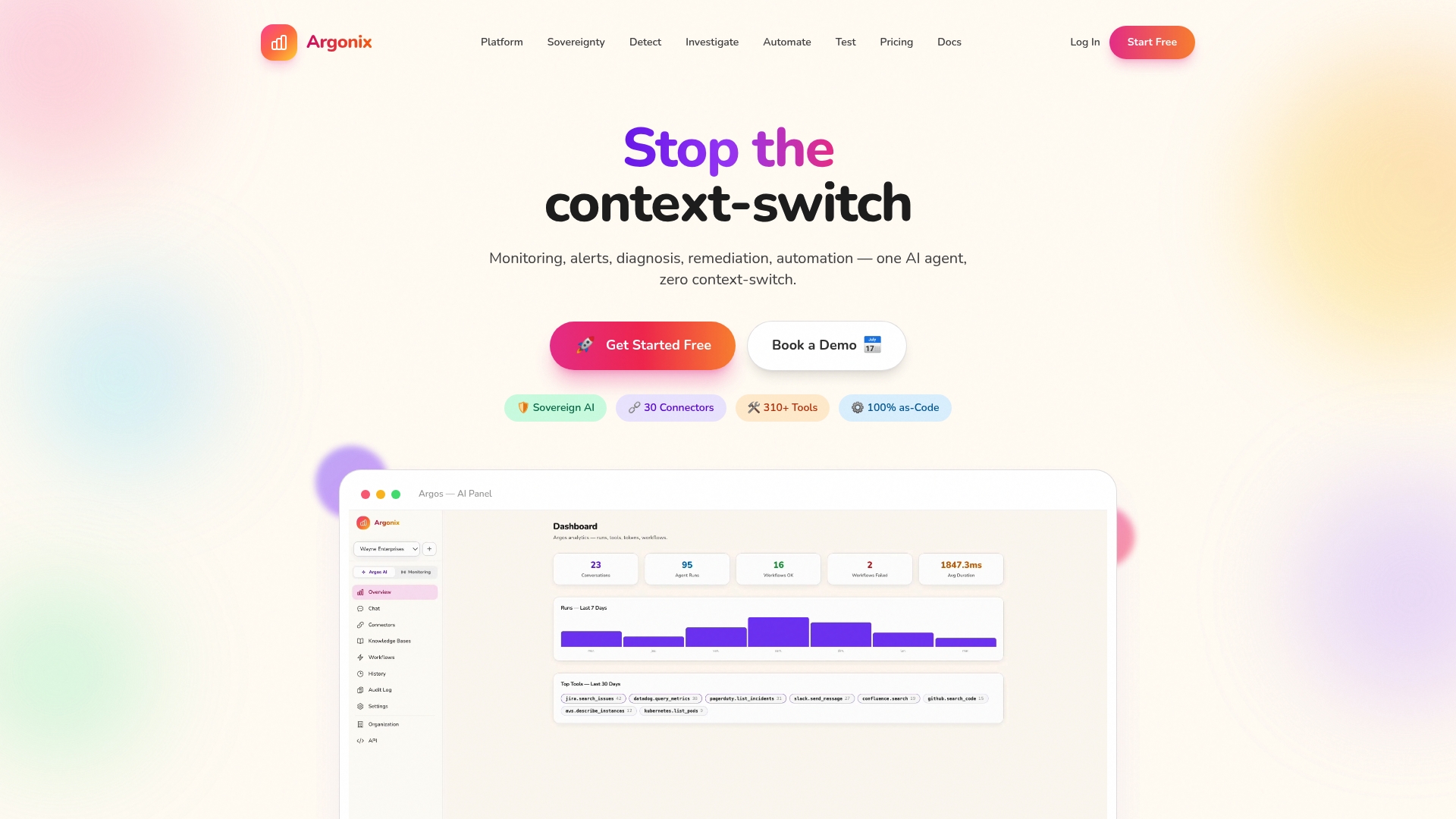
Argonix Copilot handles AI incident response with automated root cause analysis and remediation workflows that cut resolution time dramatically. The platform covers multi-cloud orchestration, monitor your infrastructure with real-time observability, and GitOps automation with Terraform and Kubernetes CRDs built in. Over 40 connectors mean you integrate with what you already use. No rip-and-replace required. Just smarter, faster, more resilient cloud ops.
Frequently asked questions
What is orchestration in multi-cloud automation?
Orchestration in multi-cloud automation refers to the coordinated management and automation of workflows, policies, and resources across multiple cloud platforms. Gartner identifies orchestration tools as one of the top technology trends shaping cloud operations in 2026.
How do AI-native platforms improve cloud operations in 2026?
AI-native platforms automate root cause detection, security response, and incident remediation, cutting resolution time from hours to seconds. AI agents now handle complex tasks like EKS troubleshooting and security response automatically.
What are KPIs for measuring automation success?
Key KPIs include reduced MTTR, increased uptime, deployment frequency, cost savings, and compliance coverage in cloud operations. Only 23% of organizations currently track these metrics as part of integrated service delivery, leaving significant room for improvement.
Why is continuous improvement important in automation?
Continuous improvement ensures your automation stays aligned with shifting business goals, evolving security standards, and infrastructure changes. Without it, even well-built pipelines drift out of sync with the environments they're meant to manage.
Recommended
- Automate cloud monitoring: AI-driven efficiency in 5 steps
- Why choose a DevOps platform: AI automation efficiency
- Argonix | AI Ops Copilot - Monitoring, Incident Response & Infrastructure Automation
- Argonix | AI Ops Copilot - Monitoring, Incident Response & Infrastructure Automation
- Why SaaS needs automation to scale efficiently in 2026