

TL;DR:
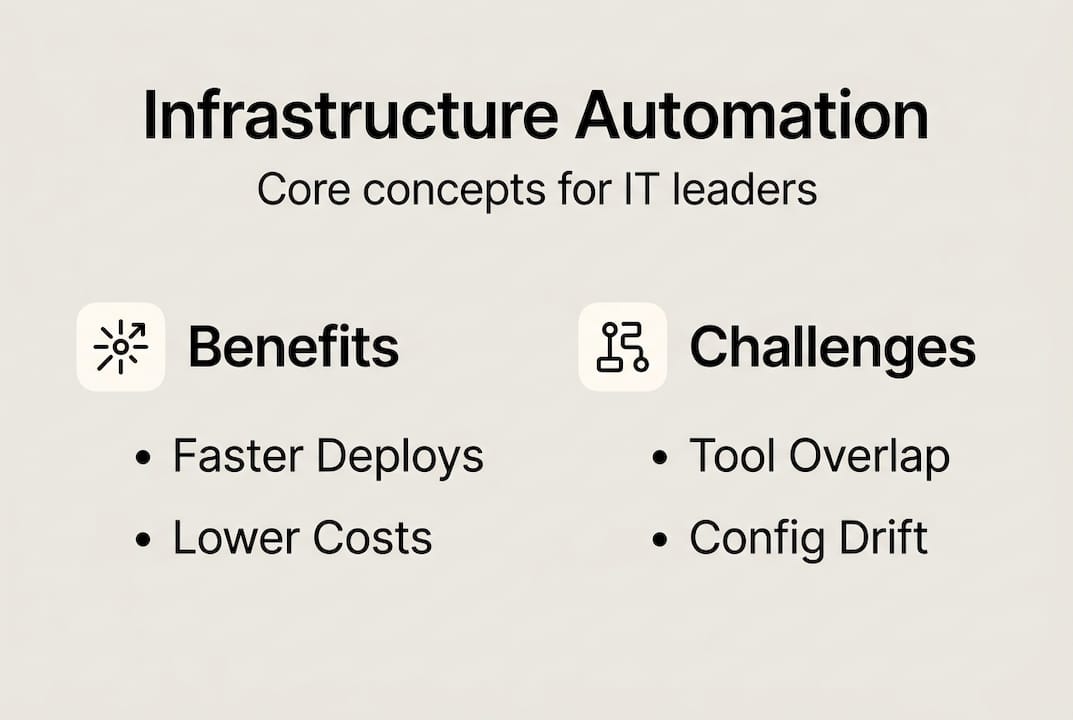
- Infrastructure automation uses software to provision and manage IT resources without manual effort.
- Proper automation leads to faster, more consistent deployments, reducing costs and outages.
- Challenges include state management, configuration drift, and multi-cloud dependencies, requiring careful planning.
Infrastructure automation promises to save your organization millions, but it can just as easily create costly chaos if you misunderstand what it actually is. Many IT leaders treat automation as a magic switch: flip it, walk away, and watch efficiency soar. Reality is messier. Automation amplifies whatever practices you already have, good or bad. If your workflows are solid, automation accelerates them. If they're fragile, automation breaks them faster and at greater scale. This guide cuts through the noise to give you a clear picture of what infrastructure automation really means, where it delivers, where it stumbles, and how to build a program that actually holds up in complex multi-cloud and DevOps environments.
Table of Contents
- What is infrastructure automation?
- The business impact: Why automation matters
- Pitfalls and challenges: What most teams miss
- Best practices for successful automation
- A fresh perspective on infrastructure automation
- Accelerate automation with Argonix
- Frequently asked questions
Key Takeaways
| Point | Details |
|---|---|
| Definition and scope | Infrastructure automation means using software to provision, configure, and manage IT resources with minimal manual effort. |
| Hard business benefits | Organizations can achieve 25-75% cost savings and major boosts to productivity, speed, and resilience. |
| Hidden challenges | Complexity, state issues, and configuration drift can derail automation if left unmanaged. |
| Best practices | Start small, monitor state, and incrementally build robust automation using proven frameworks like GitOps. |
| Real-world wisdom | Automation amplifies both good and bad habits—choose priorities and boundaries carefully for success. |
What is infrastructure automation?
At its core, infrastructure automation means using software to provision, configure, manage, and decommission IT resources without manual intervention. Instead of an engineer SSHing into servers one by one, you define your desired state in code and let tooling handle the rest. Infrastructure as code (IaC) is the foundation, but the full picture includes orchestration engines, configuration management, policy enforcement, and monitoring pipelines.
Here's how traditional manual provisioning compares with a modern automated approach:
| Dimension | Manual provisioning | Infrastructure automation |
|---|---|---|
| Speed | Hours to days | Minutes |
| Consistency | Error-prone | Repeatable by design |
| Scale | Linear with headcount | Near-unlimited |
| Audit trail | Sparse or missing | Built-in via version control |
| Cost at scale | High | Significantly lower |
The key components of a mature automation stack include:
- 🏗️ Infrastructure as code (IaC): Tools like Terraform and Pulumi codify resource definitions
- ⚙️ Configuration management: Ansible, Chef, or Puppet enforce consistent system states
- 🔄 Orchestration engines: Kubernetes and similar platforms manage workload scheduling
- 📊 Observability pipelines: Automated monitoring and alerting close the feedback loop
- 🔐 Policy as code: Guardrails that enforce security and compliance rules automatically
In a multi-cloud environment, automation becomes even more critical. You're juggling AWS, Azure, and GCP simultaneously, each with its own APIs and quirks. Doing that manually at scale is a recipe for drift, outages, and burnout. Following multi-cloud automation best practices helps teams standardize across providers without losing the flexibility each cloud offers.
The immediate payoff is speed and consistency. A new environment that used to take two days to provision now spins up in eight minutes. Every time. The same way. That repeatability is what makes automation genuinely transformative for DevOps teams running fast release cycles.
The business impact: Why automation matters
Let's talk numbers, because this is where IT leaders get buy-in from finance and the board. The data is compelling. Organizations leveraging cloud automation report 25-35% cost savings, 24% productivity improvements, and provisioning times cut by half or more. Those aren't marketing numbers. They reflect real operational shifts.
💡 Stat to know: Teams using mature automation report cutting infrastructure provisioning time by over 50% while reducing human error rates dramatically.
Here's how those gains break down across three core business outcomes:
| Outcome | What changes | Typical impact |
|---|---|---|
| Scale | Spin up environments on demand | 10x faster deployments |
| Reliability | Consistent configs, fewer drift incidents | 30-40% fewer outages |
| Innovation speed | Engineers focus on features, not toil | 24% productivity boost |
The path to those outcomes follows a clear sequence:
- Reduce toil first. Automate the repetitive, low-value tasks that eat engineer hours: patching, scaling, backup verification.
- Standardize environments. Identical dev, staging, and prod environments eliminate the classic "works on my machine" problem.
- Enable self-service. When developers can spin up compliant environments without waiting on ops, release velocity climbs fast.
- Close the feedback loop. Pair automation with infrastructure monitoring so you know immediately when something drifts from the desired state.
- Automate remediation. Automated remediation workflows mean many incidents resolve before your on-call engineer even gets paged.
The business-IT alignment angle is underrated here. When ops teams stop firefighting and start shipping reliable infrastructure as a service, the relationship between engineering and the rest of the business fundamentally improves. Finance sees lower cloud bills. Product sees faster releases. Leadership sees fewer incident post-mortems. Exploring IT automation advantages further shows how even mid-market organizations capture these gains, not just enterprise giants. And DevOps automation efficiency compounds over time as playbooks mature and teams build confidence in their pipelines.

Pitfalls and challenges: What most teams miss
Here's the part vendor pitches skip. Automation can fail spectacularly, and the failure modes are often invisible until they're catastrophic. 😱
The biggest culprit? State management. Your automation tool holds a model of what your infrastructure should look like. When reality drifts from that model, whether from a manual hotfix at 2 a.m. or a cloud provider quirk, your next automation run can overwrite critical changes or enter a conflict loop. Infrastructure idempotency is the goal, meaning running the same automation twice produces the same result, but real-world systems are rarely perfectly idempotent.
Common pitfalls your team needs to watch:
- 🔁 Non-idempotent workflows: A script that works once may fail or cause damage on re-run
- 🌐 Multi-cloud dependency cycles: Resource A in AWS depends on resource B in GCP, and your automation doesn't model that relationship cleanly
- 🔍 Configuration drift blindspots: Manual changes outside the automation pipeline silently corrupt your desired state
- 💸 Hidden costs: Automated infrastructure introduces tooling licenses, debugging complexity, and steep learning curves that erode early ROI
- 🤖 The "automate everything" trap: Not every process benefits from automation, and forcing it creates fragile, over-engineered pipelines
"The assumption that automation removes human error is dangerous. It often just moves the error earlier in the pipeline, where it's harder to spot."
Multi-cloud environments amplify every one of these risks. Each provider has different API behaviors, rate limits, and failure modes. Understanding multi-cloud automation challenges before you scale is non-negotiable. Pair that with solid cloud monitoring automation so you catch drift and anomalies before they cascade.
Pro Tip: Start with robust state monitoring before you automate aggressively. Know what your infrastructure looks like right now, and instrument alerts for any deviation. Incremental automation beats big-bang rollouts every time.
And watch the automation pitfalls that show up in adjacent domains too. The pattern of over-automating without sufficient observability is universal across industries.
Best practices for successful automation
Knowing where things go wrong is half the battle. Here's how to build an automation program that actually holds up under pressure.
- Inventory before you automate. Map every resource, dependency, and manual process. You can't automate what you don't understand. This step alone surfaces hidden complexity that would otherwise bite you later.
- Design for idempotency, plan for exceptions. Write automation that's safe to re-run, but build guardrails for the cases where it won't be. Document those exceptions explicitly.
- Version everything. Treat your automation code like application code. Use Git, enforce code review, and tag releases. GitOps automation takes this further by making your Git repository the single source of truth for infrastructure state.
- Test before you scale. Run automation in isolated environments first. Validate outputs. Only promote to production after multiple clean runs.
- Monitor continuously. Automation without observability is flying blind. Follow infrastructure monitoring best practices to close the loop between what you deployed and what's actually running.
- Refine regularly. Playbooks go stale. Schedule quarterly reviews to update automation logic as your infrastructure evolves.
The IaC approach excels at scale and consistency, but only when paired with careful state management and continuous validation. Without those guardrails, IaC becomes a liability rather than an asset.
Pro Tip: Use canary and blue-green deployment strategies when rolling out new automation. Deploy to a small slice of your environment first, validate behavior, then expand. This dramatically reduces blast radius when something unexpected happens.
Modularity matters too. Break automation into small, independently testable units rather than monolithic scripts. Compare GitOps vs traditional ops approaches to understand why modular, declarative pipelines outperform imperative scripts at scale. And revisit your automation best practices regularly. What worked at 50 services may crack at 500.
A fresh perspective on infrastructure automation
Here's the uncomfortable truth we rarely see in vendor decks: automation is a mirror. It reflects your existing practices back at you, magnified. If your team has solid runbooks, clear ownership, and strong feedback loops, automation accelerates all of that. If you have ambiguous processes, siloed knowledge, and reactive ops culture, automation just breaks things faster.
We see IT leaders focus obsessively on what to automate. The smarter question is what not to automate. Some processes are too context-dependent, too infrequent, or too risky to hand off to a script. Keeping those manual, with clear human judgment in the loop, is a feature, not a failure.
Culture and communication matter as much as tooling. The teams that succeed with automation in the real world treat it as an ongoing product with owners, roadmaps, and retrospectives. Not a one-off project that gets handed off and forgotten. Small, deliberate wins compound over time. Big-bang automation projects almost always disappoint.
Accelerate automation with Argonix
If this guide has reinforced one thing, it's that automation done right requires more than just tooling. It needs intelligence, observability, and tight feedback loops working together.
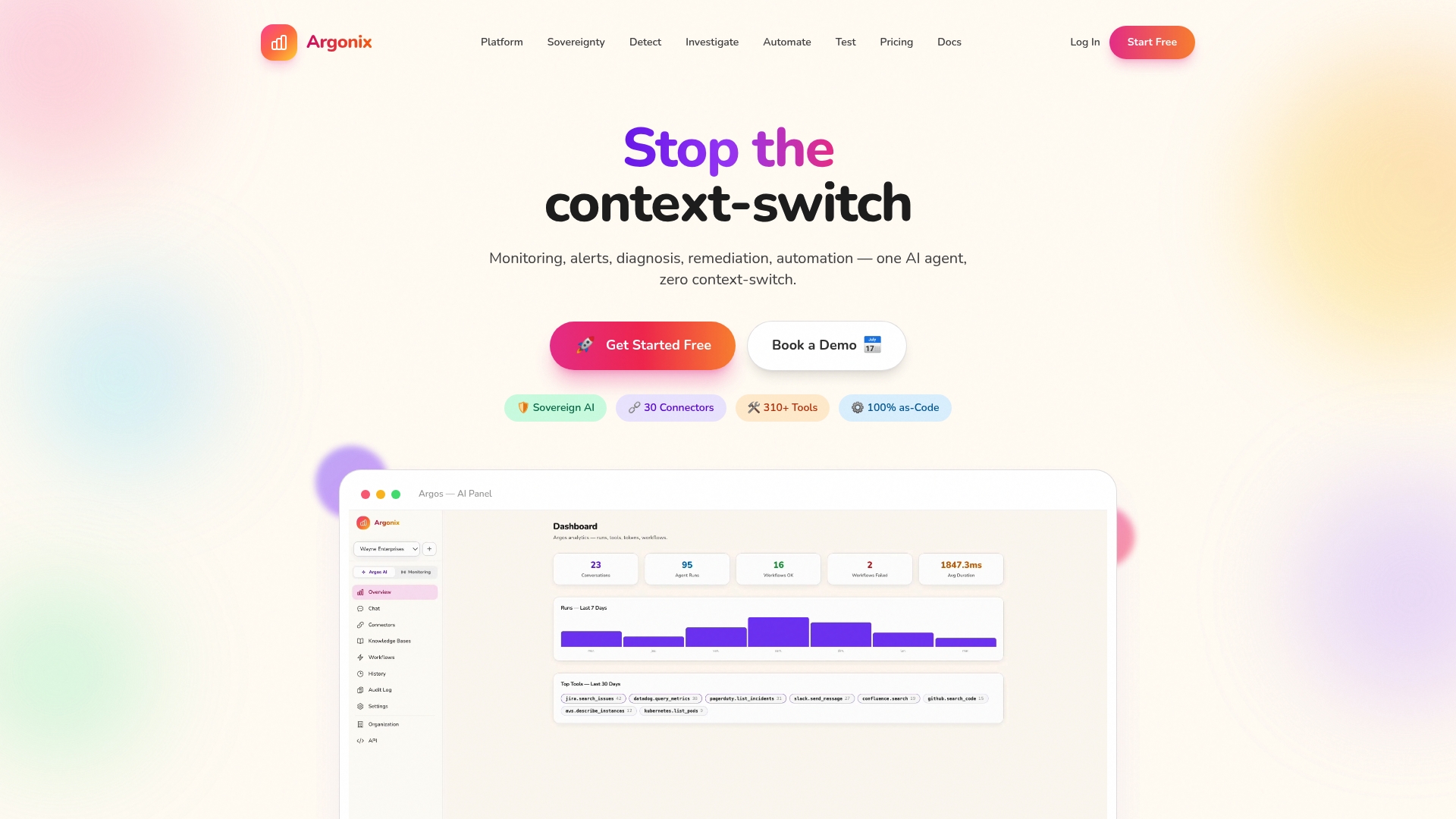
Argonix is built exactly for that reality. Our AI-driven platform connects AI incident response, infrastructure monitoring, and GitOps automation tools into one unified ops experience. Over 40 connectors span your cloud providers, CI/CD pipelines, and communication platforms. You get automated root cause analysis, auto-remediation workflows, and IaC management through Terraform and Kubernetes CRDs, all with data sovereignty built in. Ready to automate with confidence? Let's talk.
Frequently asked questions
How does infrastructure automation differ from infrastructure as code (IaC)?
Infrastructure automation is the broader category, covering orchestration, monitoring, and process automation end to end, while IaC specifically focuses on codifying and managing infrastructure resource definitions. Think of IaC as one powerful tool inside the larger automation toolbox.
What are common risks with infrastructure automation?
The biggest risks include state management issues, configuration drift, idempotency failures, and dependency cycles, all of which compound in multi-cloud environments where each provider behaves differently.
What measurable benefits can organizations expect?
Organizations commonly report 25-35% cost savings, 24% productivity gains, and provisioning times cut by more than half, with reliability improvements following as automation matures.
Is it possible to achieve 100% automation with no manual intervention?
Full automation is unrealistic in real-world distributed systems. Edge cases, context-dependent decisions, and novel failure modes will always require human judgment at some point in your operations workflow.
How should organizations get started with infrastructure automation?
Begin with a full inventory of your current infrastructure and processes, pilot automation on a well-understood, lower-risk workflow, then monitor outcomes closely and iterate before expanding scope.
Recommended
- Automation best practices for efficient multi-cloud ops
- Automate cloud monitoring: AI-driven efficiency in 5 steps
- Why choose a DevOps platform: AI automation efficiency
- Argonix | AI Ops Copilot - Monitoring, Incident Response & Infrastructure Automation
- Hoe IT-automatisering jouw mkb efficiënter maakt