

TL;DR:
- AI-driven automation now delivers measurable results like predictive incident detection and auto-remediation.
- Internal Developer Platforms are widely adopted, streamlining self-service and reducing onboarding time.
- DevOps maturity significantly influences successful AI scaling and organizational velocity.
Cloud DevOps is moving faster than most teams can absorb. New tools, frameworks, and AI capabilities drop every quarter, and the pressure to adopt the right ones before your competitors do is real. But here's the uncomfortable truth: not every trend delivers. Autonomous agents handling end-to-end tasks are reshaping how ops teams work, yet plenty of organizations are still sorting out what actually moves the needle. This guide cuts through the noise. We've pulled the most impactful, evidence-backed trends shaping cloud infrastructure and automation in 2026, so you can make smarter bets.
Table of Contents
- AI-driven automation and AIOps: From hype to business results
- Platform engineering and Internal Developer Platforms: The new DevOps standard
- GitOps 2.0 and policy-as-code: Scaling compliance in a multi-cloud world
- FinOps and cost optimization: Managing budgets in complex clouds
- DevOps maturity: Key to AI adoption and organizational velocity
- Our take: Why not every Cloud DevOps trend delivers value
- Take the next step with AI-driven DevOps solutions
- Frequently asked questions
Key Takeaways
| Point | Details |
|---|---|
| AI delivers real results | AIOps and automation now drive measurable uptime, efficiency, and predictive incident response in DevOps. |
| Platforms power developer velocity | Internal Developer Platforms are critical for productivity, reducing complexity and onboarding time for cloud teams. |
| Compliance and cost control mature | GitOps 2.0 and FinOps tools ensure multi-cloud governance and smarter budgets across the cloud lifecycle. |
| Maturity boosts success | DevOps maturity directly impacts organizations' ability to scale AI and unlock operational gains. |
AI-driven automation and AIOps: From hype to business results
With the exponential hype around AI in recent years, let's separate what truly delivers results in Cloud DevOps.
AIOps has crossed a threshold. It's no longer a research project or a vendor pitch. Autonomous agents now handle end-to-end tasks, including self-healing infrastructure, predictive scaling, and automated root cause analysis. Your on-call engineer doesn't need to wake up at 3am for a memory leak that an AI agent already patched and closed.
But the story has a twist. 2026 demands ROI proof and human approval boundaries for agents. Pure autonomous execution is getting pushback. Teams that deployed fully autonomous remediation are now adding approval gates for high-risk actions. That's not a step backward. That's maturity.
Here's what's actually delivering value right now:
- Predictive incident detection: AI models flag anomalies before they become outages, cutting mean time to detect (MTTD) significantly
- Auto-remediation workflows: Routine fixes like pod restarts, disk cleanups, and config rollbacks run without human touch
- Intelligent alerting: Context-aware alerts reduce noise by correlating signals across your entire stack
- Capacity forecasting: AI-driven scaling decisions reduce both over-provisioning and surprise brownouts
The open source fatigue problem is real too. Teams are no longer adopting every new AI tool that ships. They're being selective, evaluating tools against specific use cases and measurable outcomes before committing.
"The teams winning with AIOps in 2026 aren't the ones with the most tools. They're the ones with the clearest success criteria."
Pro Tip: Before deploying any AI agent in production, define your approval boundaries explicitly. Decide which actions run automatically and which require a human sign-off. This keeps your team in control while still capturing the speed benefits. Check out AI agent capabilities and pitfalls and multi-cloud automation best practices before you commit to a specific architecture.
Platform engineering and Internal Developer Platforms: The new DevOps standard
While AIOps is automating remediation, platform engineering is transforming the developer experience itself.

Internal Developer Platforms (IDPs) are no longer a nice-to-have. IDPs are now adopted by 65% of Fortune 500 companies, providing self-service golden paths and abstracting Kubernetes complexity. That stat should catch your attention if your team is still managing infrastructure requests through Jira tickets and Slack DMs.
📊 65% of Fortune 500 companies now run IDPs as their standard developer interface for infrastructure provisioning.
Here's why platform engineering is sticking:
- Self-service provisioning: Developers spin up environments without waiting on ops. No ticket queue, no back-and-forth.
- Golden paths: Standardized, pre-approved workflows reduce configuration drift and policy violations
- Abstracted complexity: Kubernetes, Crossplane, and other infrastructure layers are hidden behind clean interfaces
- Faster onboarding: New engineers ship code in days, not weeks, because the environment is already configured correctly
The shift from tool-centric to platform-centric thinking is significant. Dev and prod environments are converging. Teams that once maintained completely separate toolchains are now running unified platforms that enforce consistency from commit to production.
Pro Tip: When building or evaluating an IDP, prioritize the golden path experience first. A platform that forces developers to learn new abstractions before they can be productive defeats the purpose. Start with the most common workflows and expand from there.
For teams looking to accelerate this shift, DevOps platform automation efficiency and DevOps communication platforms are worth exploring as you design your IDP strategy.
GitOps 2.0 and policy-as-code: Scaling compliance in a multi-cloud world
As the DevOps stack evolves, let's see why GitOps 2.0 and policy-as-code are reshaping compliance and multi-cloud orchestration.
GitOps 2.0 adoption now sits between 64% and 91% across organizations, covering multi-cluster management, policy-as-code enforcement, and hybrid deployments. That range reflects maturity differences, but the direction is clear: declarative, Git-driven operations are the standard.
Here's how the evolution looks across practices:
| Practice | Control model | Compliance approach | Scale capability |
|---|---|---|---|
| Legacy ops | Manual, imperative | Audit after the fact | Limited |
| GitOps 1.0 | Declarative, single cluster | Deploy-time checks | Moderate |
| GitOps 2.0 | Declarative, multi-cluster | Continuous enforcement | High |
The critical shift in GitOps 2.0 is when policy enforcement happens. Legacy approaches check compliance at deploy time. GitOps 2.0 enforces policies continuously, across every cluster and every environment.
Here's how teams are implementing it:
- Define policies as code using tools like OPA (Open Policy Agent) or Kyverno, stored in Git alongside application configs
- Enforce across clusters with tools like Pulumi, OpenTofu, or Crossplane managing multi-cloud resources declaratively
- Automate drift detection so any manual change triggers an alert and automatic reconciliation
- Integrate policy gates into CI/CD pipelines so non-compliant changes never reach production
"Policy-as-code turns compliance from a quarterly audit into a continuous, automated guarantee."
For teams ready to operationalize this, GitOps automation solutions and a clear understanding of GitOps vs traditional operations will save you significant rework.
FinOps and cost optimization: Managing budgets in complex clouds
Delivering true value from cloud at scale depends on more than just automation and compliance. It's also about controlling runaway costs.
Cloud bills are a serious problem. AI-driven forecasting now achieves within 5% accuracy, making FinOps a precision discipline rather than a guessing game. But the benchmarks also reveal something interesting about where your money actually goes.
| Provider | Market share | Best for | Egress cost |
|---|---|---|---|
| AWS | 28% | General compute | $0.09/GB |
| Azure | 21% | Enterprise hybrid | Varies |
| GCP | 14% | Data and ML workloads | Competitive |
With multi-cloud adoption at 89%, most teams are managing spend across at least two providers. That creates arbitrage opportunities, but also complexity.
The hidden killer? Egress fees. Moving data out of AWS costs $0.09 per GB. At scale, that adds up fast. Teams running large data pipelines between clouds often discover egress is their third or fourth largest cloud line item. 😱
Here's how high-performing teams are optimizing:
- Continuous rightsizing: AI tools analyze actual utilization and recommend instance changes weekly, not annually
- Policy-based scheduling: Non-production workloads automatically shut down outside business hours
- Multi-cloud arbitrage: Route workloads to the cheapest provider for each job type based on real-time pricing
- Egress architecture review: Minimize cross-cloud data transfers by co-locating dependent services
Pro Tip: Run a dedicated egress audit before your next budget cycle. Most teams are shocked by what they find. Pair it with efficient multi-cloud ops strategies to build cost awareness into your automation layer.
DevOps maturity: Key to AI adoption and organizational velocity
Even with the latest trends, organizational maturity is the multiplier for true DevOps and AI value.
70% of organizations report DevOps maturity affects AI scaling, and the gap between high and low maturity is stark. High-maturity organizations embed AI across 72% of their software lifecycle. Low-maturity organizations? Just 18%.
Here's how to build toward higher maturity:
- Invest in collaboration tooling that connects dev, ops, and security teams around shared signals
- Measure rework rate as a core metric alongside deployment frequency and change failure rate
- Prioritize stability in automation workflows before chasing throughput gains
DORA metrics show AI boosts throughput but can hurt stability, which is why rework rate is now tracked as a fifth key metric.
Maturity isn't a checkbox. It's a continuous investment in how your team works together.
Our take: Why not every Cloud DevOps trend delivers value
Here's the contrarian view we feel strongly about: trend momentum is not the same as business value.
We've watched teams chase every new framework, only to end up with more complexity and slower delivery. The open source fatigue and demand for ROI proof in 2026 is a healthy correction. It means the industry is growing up.
Trend fatigue is real. Over-automation creates fragile systems. Adopting too many open source tools at once creates maintenance debt that quietly kills velocity. We've seen it happen to smart teams with strong engineers.
Our honest advice:
- Test before you commit. Run a 30-day pilot with clear success criteria before any major adoption decision
- Build in evaluation cycles. Quarterly reviews of your toolchain keep you from accumulating dead weight
- Retain human approval for high-impact automated actions, especially in production
- Focus on foundational maturity first. The teams getting the most from AI are the ones who already had solid CI/CD, observability, and incident practices in place
Understanding pitfalls of AI agents before you deploy them at scale will save you a painful rollback later. Trust us on that one.
Take the next step with AI-driven DevOps solutions
Ready to operationalize 2026's biggest trends? The patterns we've covered, from AIOps and GitOps 2.0 to FinOps optimization, require a platform that connects them without creating more silos.
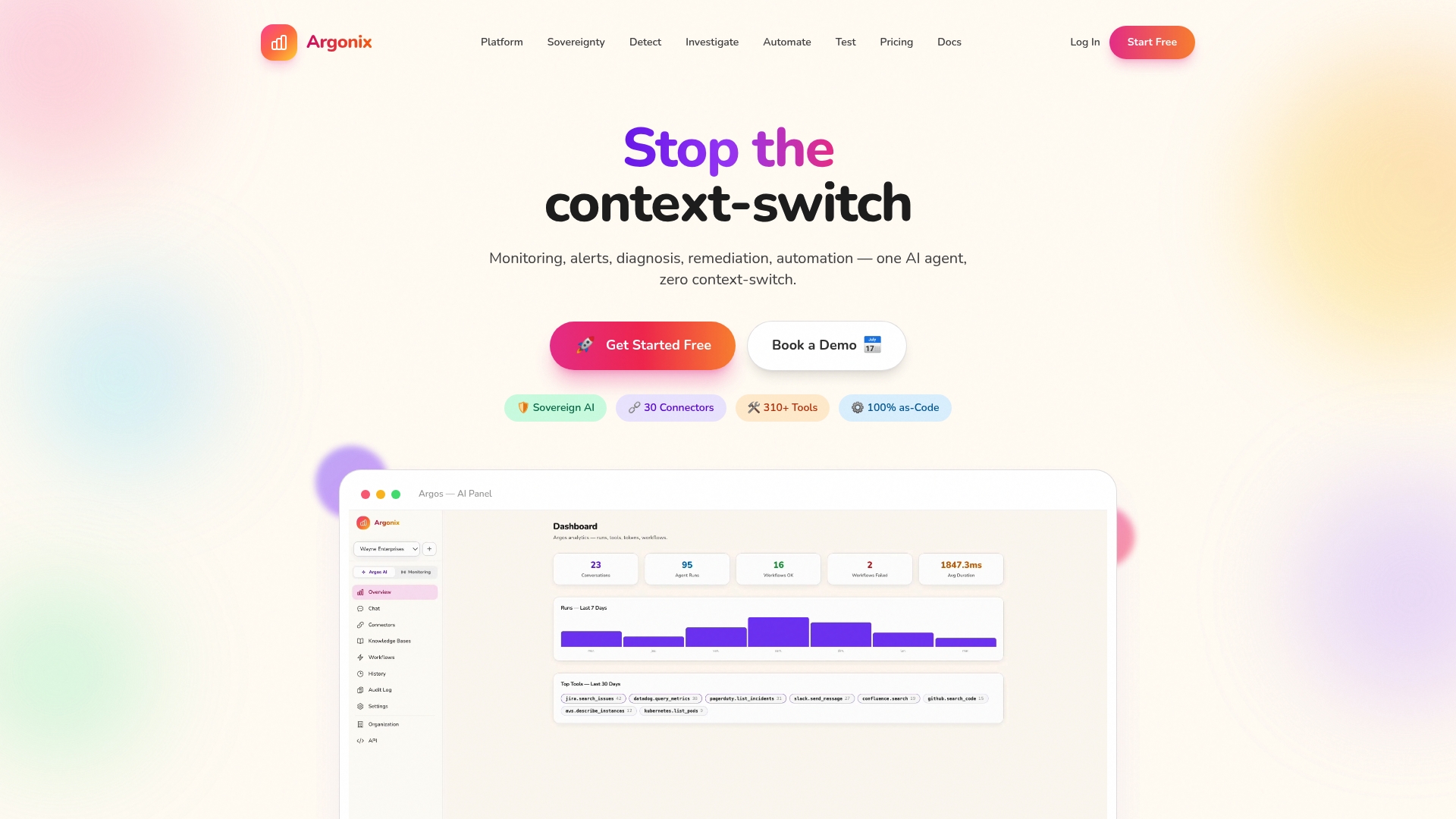
Argonix is built for exactly this. Our platform delivers AI incident response with automated root cause analysis and approval-gated remediation, GitOps automation with continuous policy enforcement across multi-cluster environments, and infrastructure monitoring with cost visibility baked in. Over 40 connectors mean your existing stack integrates without rework. If your team is serious about turning these trends into real operational gains, we'd love to show you how Argonix makes that happen.
Frequently asked questions
What is the main advantage of AIOps in Cloud DevOps in 2026?
AIOps automates end-to-end processes, enabling self-healing systems and real-time issue prediction for vastly improved uptime and efficiency. It removes the manual toil from routine incident response so your team focuses on higher-value work.
Why are Internal Developer Platforms (IDPs) so popular in 2026?
IDPs give developers self-service access to infrastructure and tools while simplifying complex workflows, leading to faster deployment and reduced onboarding friction. 65% of Fortune 500 companies have already adopted them as their standard developer interface.
How accurate are AI-powered cloud cost forecasts now?
AI-driven cloud cost forecasting now routinely achieves within 5% accuracy, making budgets more predictable and enabling smarter multi-cloud spend decisions.
How does DevOps maturity impact AI adoption?
Organizations with mature DevOps practices embed AI throughout 72% of their software lifecycle and scale initiatives far more successfully. DevOps maturity directly affects AI scaling according to 70% of organizations surveyed in 2026.
Recommended
- Argonix | AI Ops Copilot - Monitoring, Incident Response & Infrastructure Automation
- Automation best practices for efficient multi-cloud ops
- Why choose a DevOps platform: AI automation efficiency
- Argonix | AI Ops Copilot - Monitoring, Incident Response & Infrastructure Automation
- 10 Cloud Security Best Practices for 2025 - Heights Consulting Group
- Security Hardening & DevOps | Rich Harrington