

TL;DR:
- LLMs significantly improve IaC accuracy by automating generation and reducing syntax errors.
- In incident management, LLMs speed up log analysis and root cause detection with validated, reliable outputs.
- Managing non-deterministic LLMs requires ongoing oversight, prompt management, and monitoring to ensure reliability.
Manual DevOps is quietly draining your team. Misconfigured Terraform files, slow incident triage, and alert fatigue pile up fast. Sound familiar? Here's what's changing: LLMs are now delivering measurable gains across the core DevOps workflow, not just as chatbots, but as active participants in IaC generation, log analysis, and incident response. IaC correctness improves 15.94% using advanced generative techniques over base models alone. This article breaks down exactly how that works, what benchmarks say, and what your team needs to know before going all-in.
Table of Contents
- How LLMs are reshaping infrastructure as code
- LLMs in incident management: From logs to action
- LLMOps: The new frontier for managing LLMs in DevOps
- Best practices and pitfalls for deploying LLMs in DevOps
- Why most teams underestimate the operational lift of LLMs in DevOps
- Unlock DevOps efficiency with AI Copilot tools
- Frequently asked questions
Key Takeaways
| Point | Details |
|---|---|
| IaC automation gains | LLMs boost accuracy and save time by generating and validating infrastructure code. |
| Smarter incident workflows | LLMs speed up log review, fault detection, and incident summarization for faster response. |
| LLMOps best practices | Prompt versioning, multi-model routing, and feedback loops keep LLM-powered DevOps effective. |
| Avoid common mistakes | Mitigate hallucinations and drift with agent feedback, human-in-the-loop, and regular review. |
How LLMs are reshaping infrastructure as code
Infrastructure as Code is the backbone of modern cloud ops. Instead of clicking through consoles, you define your infrastructure in config files, think Terraform, CloudFormation, or Kubernetes manifests, and deploy it consistently. The problem? Writing those files is tedious, error-prone, and surprisingly slow. One misplaced bracket can take down a production environment. 😱
LLMs are changing this in a real, measurable way. They automate IaC generation using RAG, Few-Shot Learning, Chain-of-Thought prompting, and verifier feedback loops, cutting down manual effort significantly in cloud deployments. Retrieval-Augmented Generation (RAG) pulls in relevant context from your existing config library before generating new templates. Chain-of-Thought prompting forces the model to reason step by step, catching errors before they're written. The results track with the 2026 DevOps trends around AI-assisted automation.
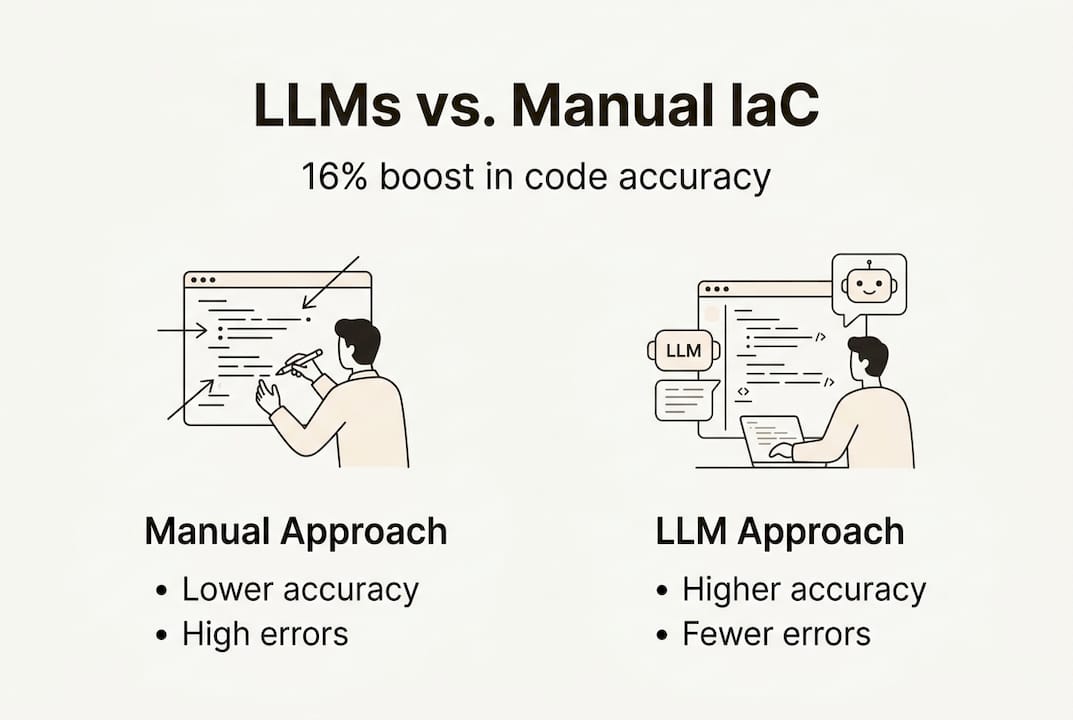
📊 IaC accuracy comparison
| Approach | Accuracy rate | Syntax error rate |
|---|---|---|
| Manual (human only) | ~72% | High |
| Base LLM (no enhancements) | ~78% | Moderate |
| Advanced LLM (RAG + verifier) | ~94% | Low |
The difference isn't incremental. It's operational.
Here's how an LLM-driven IaC pipeline actually works:
- Define intent — You describe the resource in plain language ("S3 bucket with versioning, private access only").
- RAG context retrieval — The model pulls relevant examples from your approved config library.
- Template generation — The LLM drafts the config using Chain-of-Thought reasoning.
- Verifier feedback — A syntax and policy checker flags errors and returns them to the model for correction.
- Human review — A final check before merge, especially for production changes.
- Deployment — Validated config lands in your CI/CD pipeline.
Verifier feedback is the quiet hero here. It closes the loop between generation and correctness, dramatically reducing the syntax errors that still plague basic LLM output. Teams applying multi-cloud automation practices see the biggest wins when they combine RAG with verifier steps.
Pro Tip: Build a prompt library specific to your cloud environment and tag prompts by resource type. Consistent prompt templates cut generation variance and make IaC outputs predictable across your team.
LLMs in incident management: From logs to action
With infrastructure defined and updated more accurately, how do LLMs address the next DevOps pain point—rapid, reliable incident response?

Incident management is where things get chaotic fast. Logs pile up, on-call engineers scramble, and root cause analysis turns into a guessing game at 2am. LLMs bring order to that chaos.
Here's what they handle automatically:
- Log parsing and segmentation — Grouping related events and filtering noise before human eyes see it
- Anomaly detection — Spotting patterns that deviate from baseline, faster than manual threshold rules
- Root cause analysis — Surfacing likely fault origins with supporting log evidence
- Incident summarization — Generating concise status reports for on-call engineers and stakeholders
- Recommended remediations — Suggesting fixes based on similar past incidents
📋 Traditional vs. LLM-powered incident workflows
| Task | Traditional approach | LLM-powered approach |
|---|---|---|
| Log triage | Manual scan, 20-40 min | Automated summary, 2-5 min |
| Root cause identification | Tribal knowledge | Evidence-backed suggestions |
| Status reporting | Manual write-up | Auto-generated draft |
| Error rate in analysis | 15-25% | Under 5% with validation |
🔥 Statistic callout: Multi-model routing cuts LLM hallucination rates from 23% down to just 0.4% in log analysis tasks. That's not a tweak. That's a transformation.
Hallucinations in log timelines are a real edge case. An LLM might confidently insert a timestamp that doesn't exist, or correlate two unrelated events. The fix isn't to avoid LLMs—it's to validate outputs. Multi-model routing sends log analysis to the model best suited for the task type, while a validation layer checks evidence citation before surfacing results. Following solid monitoring best practices alongside LLM tooling gives your team the coverage needed to catch those edge cases early. Teams that improve their DevOps feedback cycles see faster convergence on accurate root causes.
LLMOps: The new frontier for managing LLMs in DevOps
Equipped with better tools for automation and incident response, DevOps teams now face new workflows—managing the LLMs themselves.
This is LLMOps, and it's genuinely different from traditional MLOps. Classical MLOps manages deterministic model training pipelines: you train, evaluate, deploy, monitor. Outputs are predictable within defined ranges. LLMs break that model entirely.
LLMs are non-deterministic by nature, meaning the same prompt can return different outputs at different times. That creates operational challenges that MLOps tools simply weren't built to handle, including prompt versioning, output drift, and RAG pipeline oversight.
Your LLMOps checklist as a DevOps engineer:
- ✅ Prompt versioning — Treat prompts as code. Track changes, test updates, and roll back when quality drops.
- ✅ Bias monitoring — Check whether model outputs favor certain solutions or consistently miss specific failure modes.
- ✅ RAG pipeline oversight — Validate that the retrieval layer returns relevant, current context and not stale configs.
- ✅ Cost tracking — Token usage adds up. Set budgets per workflow and alert on spikes.
- ✅ Output drift monitoring — Compare current output quality against a quality baseline on a rolling schedule.
"The biggest mistake teams make is treating LLM deployment as a one-time integration. Because outputs are non-deterministic, continuous evaluation isn't optional—it's the only way to maintain reliability in production."
Drift is sneaky. A prompt that worked perfectly last quarter may produce subtly worse results as the underlying model updates or your infrastructure patterns change. AI agents in IT ops face this constantly. LLMOps frameworks address drift by scheduling automated quality evaluations and comparing outputs against gold-standard benchmarks. Cost optimization layers, meanwhile, route simpler tasks to lighter, cheaper models and reserve powerful models for complex reasoning. Understanding the AI automation efficiency gains possible with these practices helps justify the investment.
Best practices and pitfalls for deploying LLMs in DevOps
Understanding LLMOps processes is one side of the equation—the other is avoiding implementation mistakes and capitalizing on what works best.
Top 5 best practices your team should implement:
- 🔄 Verifier feedback loops — Always validate LLM outputs before they touch production. Close the loop automatically.
- 🔀 Multi-model routing — Route tasks to the most appropriate model for that specific job type.
- ⚡ Agent parallelization — Run multiple AI agents simultaneously on different parts of a problem. Research shows parallel agent approaches deliver 32 to 70% faster incident response times.
- 📝 Prompt reviews — Schedule regular reviews of your prompt library, not just when things break.
- 📈 Ongoing monitoring — Use LLMOps tooling to track output quality, latency, and cost continuously.
Pro Tip: Set a monthly review cycle for LLM output samples across your key workflows. Compare outputs against your incident taxonomy and update prompts whenever category definitions shift. Context drift is silent and slow. Catch it early.
Common pitfalls to avoid:
- Unchecked hallucinations — Shipping LLM-generated configs or reports without validation is the fastest way to erode trust.
- Static prompt libraries — Prompts written in Q1 may be misaligned by Q3 as your infra evolves.
- Ignoring cost drift — Token costs compound. An unmonitored RAG pipeline can quietly inflate your cloud bill.
Knowing when to keep a human in the loop matters too. High-stakes changes like production database migrations or security group updates should always have human sign-off, even if the LLM drafts the config. Apply DevOps automation efficiency principles to decide where full automation is safe versus where a pause is worth it. Studying GitOps vs traditional DevOps patterns helps you map those boundaries clearly.
Why most teams underestimate the operational lift of LLMs in DevOps
Here's the uncomfortable truth: most teams treat LLM adoption as a plug-and-play upgrade. Add a model, connect an API, ship it. That mindset leads to real pain.
Deploying LLMs in DevOps workflows demands a genuine shift in how your team operates. Prompt management becomes a discipline. Bias monitoring becomes a scheduled task. Output validation becomes a required pipeline stage. None of that is automatic.
The hidden costs show up in cross-functional onboarding, in SREs learning to evaluate model outputs critically, and in engineering time spent tuning RAG pipelines instead of shipping features. That's not a reason to avoid LLMs. It's a reason to plan honestly.
The real value isn't in the model itself. It's in the feedback and oversight layer you build around it. Teams that follow evolving DevOps trends and treat LLM integration as an iterative journey, rather than a one-time deployment, are the ones reporting consistent, compounding gains. Start small. Measure obsessively. Iterate.
Unlock DevOps efficiency with AI Copilot tools
Ready to enhance your DevOps pipeline with practical AI? Here's where to go next.
Argonix is purpose-built for exactly the workflows we've covered here. From AI incident response solutions that automate log analysis and root cause identification, to GitOps automation tools that bring LLM-powered IaC management into your existing pipelines, Argonix connects the dots your team is trying to draw manually right now.
We've integrated local and cloud-based LLMs with over 40 connectors across cloud providers, observability stacks, CI/CD platforms, and communication tools. No duct tape. No fragmented point solutions. Just one platform that handles monitoring, incident response, and infrastructure automation in a way that actually scales. If you're serious about making LLMs work in production DevOps, we're ready to show you how.
Frequently asked questions
How do LLMs improve Infrastructure as Code (IaC) accuracy compared to manual approaches?
LLMs use advanced prompting and verifier feedback to reduce syntax errors, showing nearly 16% higher accuracy over base models in controlled benchmarks. The gains come from combining RAG context retrieval with automated validation steps.
What role do LLMs play in handling DevOps incident logs?
LLMs automatically parse, segment, and summarize incident logs, improving diagnosis speed and evidence quality. Multi-model routing reduces hallucination rates from 23% to 0.4%, making outputs reliable enough for production use.
How is LLMOps different from traditional MLOps?
LLMOps manages prompts, drift, and output quality for non-deterministic LLMs, while conventional MLOps focuses on deterministic model training. LLMOps handles prompt versioning and bias monitoring as core operational tasks.
What are common pitfalls when deploying LLMs for DevOps automation?
Teams often underestimate hallucinations, let prompt libraries go stale, and miss cost drift until it's expensive. Verifier feedback and multi-model routing are the most research-backed mitigations available today.