

TL;DR:
- DevOps project management focuses on continuous delivery, feedback, and cross-functional collaboration.
- Measuring key metrics like DORA guides process improvements and demonstrates business value.
- Successful transformation requires cultural change, process alignment, and leadership commitment.
Most teams assume DevOps is a technology problem. Buy the right tools, set up CI/CD pipelines, automate deployments, done. But that mindset is why so many DevOps transformations stall six months in. Project management in DevOps is what actually integrates development and operations teams, aligns stakeholders, and creates the feedback loops that turn automation investments into real business outcomes. Without it, you get faster deployments into the same broken, siloed workflows. This guide covers frameworks, roles, metrics, and practical steps to help project managers lead DevOps adoption the right way.
Table of Contents
- What makes DevOps project management unique?
- How project management drives collaboration and efficiency
- 📊 Measuring DevOps performance: The DORA metrics and PM's role
- 🔄 Overcoming challenges: Governance, tool sprawl, and cultural shifts
- What most teams get wrong about DevOps project management
- Take your DevOps integration further with Argonix
- Frequently asked questions
Key Takeaways
| Point | Details |
|---|---|
| Bridges collaboration gaps | Project management unifies Dev, Ops, QA, and Security to accelerate delivery and reduce silos in DevOps. |
| Enables data-driven success | Using DORA metrics, PMs track and optimize team efficiency for measurable performance improvements. |
| Adapts Agile and Lean methodologies | Modern DevOps project management relies on iterative, feedback-driven approaches tailored to tech environments. |
| Overcomes scaling challenges | Project managers handle tool sprawl, governance, and cultural adoption for seamless DevOps transformations. |
| Drives real outcomes | Integrated PM and DevOps deliver faster sprints, better satisfaction, and fewer workflow bottlenecks. |
What makes DevOps project management unique?
Traditional project management works great for predictable, sequential work. You define scope, build a waterfall schedule, hand deliverables from team to team, and close the project. Clean. But software development in 2026 is not predictable or sequential. Requirements change mid-sprint. A deploy breaks production at 2 a.m. A compliance audit lands during your biggest release cycle. 😱
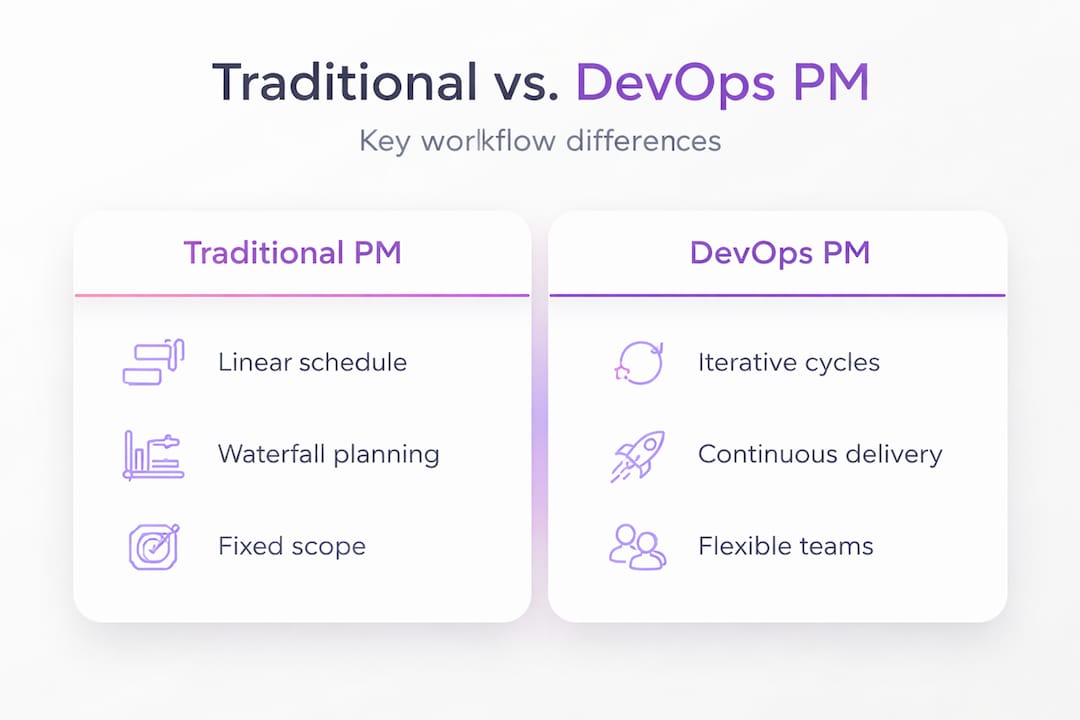
DevOps project management requires a fundamentally different operating model. Instead of managing toward a fixed end date, you're managing continuous delivery, feedback, and improvement. Key DevOps methodologies include Agile frameworks like Scrum and Kanban, Lean principles applied across the full DevOps lifecycle, and a relentless emphasis on iterative delivery, real-time feedback loops, and cross-functional team ownership. That's a big shift from handing a Gantt chart to a steering committee.
Here's how the two models compare side by side:
| Dimension | Traditional PM | DevOps PM |
|---|---|---|
| Planning horizon | Long, fixed phases | Short sprints, rolling plans |
| Team structure | Siloed by function | Cross-functional squads |
| Delivery model | Sequential handoffs | Continuous delivery |
| Success measure | On-time, on-budget | Deployment frequency, MTTR |
| Feedback cadence | End-of-phase reviews | Daily standups, sprint retros |
| Risk approach | Upfront risk registers | Ongoing, iterative mitigation |
The PM role doesn't disappear in DevOps. It evolves. Your job shifts from controlling a plan to enabling a system. You're coordinating across Dev, QA, Ops, and Security simultaneously. You're tracking metrics that measure flow, not just task completion. And you're the person making sure collaboration actually happens, not just gets scheduled.
"The project manager in a DevOps environment is less a gatekeeper and more a force multiplier for the teams doing the work." — Common insight from DevOps transformation leads.
For mid-sized tech companies exploring DevOps automation platforms, this distinction matters a lot. Tools can automate pipelines, but they cannot automate trust between a senior dev and an Ops engineer who've historically blamed each other for outages. That's where your PM practice comes in. And if you want to understand where these practices are heading, take a look at the DevOps trends for 2026 that are reshaping how teams organize and deliver.
How project management drives collaboration and efficiency
With the core differences clear, let's get concrete. What does integrated PM actually do for DevOps teams day to day?
The simplest way to think about it: DevOps PM removes friction. Every bottleneck between Dev, QA, Ops, and Security represents lost time and lost trust. Your job is to map those bottlenecks, make them visible, and drive the team toward removing them systematically. DevOps integration in project management focuses on CI/CD pipelines, automation adoption, and breaking down silos to speed delivery and reduce rework.
And the results can be dramatic. A mid-sized fintech team with 25 developers improved sprint success rates from 65% to 88% and achieved 40% faster delivery after integrating project management workflows with their DevOps toolchain. That's not from buying new tools. That's from improving how the team works together.
📋 Practical steps for mid-sized organizations to get started:
- Run a pilot with one cross-functional team. Don't try to transform everyone at once. Pick one squad with Dev, QA, and Ops representation and implement a unified workflow.
- Map your current handoff points. Where does work sit waiting? Where does context get lost? These are your biggest opportunity areas.
- Standardize your project tracking in one place. Tools like Jira or Azure DevOps give real-time visibility across functions. Pick one and commit.
- Define done across all functions. Dev's "done" and Ops' "done" are often wildly different. Align on a shared definition before sprint planning.
- Hold regular cross-functional retros. Not just dev retros. Bring Ops and QA into the retrospective loop so improvements are systemic, not local.
- Measure early and often. Baseline your sprint success rate, deployment frequency, and incident count before the pilot. Then measure again at 30, 60, and 90 days.
- Scale what works. Once the pilot team shows results, document the process changes and expand them to adjacent teams.
For practical guidance on improving DevOps team feedback, communication tooling plays a central role. Slack integrations, incident channels, and shared dashboards all help, but only when the PM is actively structuring how the team uses them. Understanding GitOps vs. traditional Ops is also useful context for PMs who want to speak credibly with their engineering leads about workflow automation.
Pro Tip: Avoid tool sprawl at all costs. Every new tool your team adopts adds cognitive load and creates new integration headaches. Focus on unifying workflows in the fewest tools possible before adding anything new. Visible, centralized workflows beat fragmented, "best of breed" stacks every time.
📊 Measuring DevOps performance: The DORA metrics and PM's role
You can't improve what you don't measure. And for DevOps teams, the gold standard measurement framework is DORA metrics.
DORA (DevOps Research and Assessment) identifies four key metrics that predict software delivery performance and organizational outcomes. DORA metrics benchmark DevOps teams across four dimensions:
| DORA Metric | What it measures | Elite benchmark | Low performer |
|---|---|---|---|
| Deployment frequency | How often code ships to production | Multiple times per day | Once per month or less |
| Lead time for changes | Time from commit to production | Less than 1 day | More than 1 month |
| Change failure rate | % of deployments causing incidents | 0% to 5% | Greater than 15% |
| Mean time to recovery (MTTR) | Time to restore after an incident | Less than 1 hour | More than 1 month |
The gap between elite and low-performing teams is staggering. Elite teams deploy far more frequently and recover from incidents in minutes instead of weeks. That performance gap translates directly to business outcomes: faster feature delivery, lower incident costs, and higher customer satisfaction.

Here's where your PM role becomes critical. DORA metrics don't improve by accident. They improve when someone is actively tracking them, analyzing workflow data, spotting patterns, and driving the organizational changes that move the numbers. That someone is you.
Team structure directly impacts these metrics in measurable ways. Cross-functional teams that integrate Dev and Ops functions (rather than keeping them separate) consistently show lower lead times, lower MTTR, and fewer production incidents. Structure is not a soft topic. It's a performance lever.
🎯 What PMs should be doing with DORA data:
- Baseline all four metrics before any process changes so you have real before/after comparisons.
- Run monthly DORA reviews with your engineering leads and Ops team, not just in retrospectives.
- Identify which metric is your biggest constraint and focus team energy there first instead of trying to improve everything simultaneously.
- Connect metric improvements to business outcomes so leadership sees the ROI of DevOps investment.
- Use deployment frequency as a leading indicator of team health. Teams that are deploying rarely are usually blocked by process, not capability.
For deeper context on keeping your infrastructure data clean and actionable, explore monitoring best practices that complement your DORA tracking with real-time observability.
🔄 Overcoming challenges: Governance, tool sprawl, and cultural shifts
These gains don't come without friction. DevOps adoption in mid-sized tech companies runs into predictable obstacles, and PMs need to anticipate them rather than react to them after the damage is done.
Compliance vs. speed is the tension that never fully goes away. In regulated industries, finance, healthcare, insurance, you have to balance DevOps velocity with ITIL governance requirements and audit trails. Regulated mid-sized firms need their PMs to integrate incident management and change advisory processes directly into agile planning, not treat them as separate bureaucratic layers. The solution isn't to slow down DevOps. It's to embed compliance checkpoints into your CI/CD workflow so governance happens automatically, not as a gate.
The PM mindset shift is harder than most people expect. DevOps PM fundamentally changes the focus from schedule management to automation oversight, monitoring, and feedback loop cadence. PMs who cling to Gantt charts and status reports as their primary outputs will frustrate engineering teams and miss the real value they could be adding. The shift is from controlling delivery to enabling delivery.
🔥 Common challenges and how to address them:
- Resistance from engineering leads who see PM as overhead. Fix this by proving value early through visible metrics improvements in the pilot team.
- Tool chaos where each function uses its own tracking system. Fix this by establishing a single source of truth in sprint planning, even if other tools exist alongside it.
- Governance gaps where speed creates compliance risk. Fix this by mapping your change management process to your CI/CD pipeline so approvals are automated where possible.
- Cultural silos that survive even after org chart changes. Fix this through joint retros, shared OKRs across Dev and Ops, and deliberately rotating team members through cross-functional work.
- Leadership misalignment where executives expect DevOps to deliver big results immediately. Fix this by setting realistic 90-day milestones and communicating DORA progress regularly.
"The biggest risk in a DevOps transformation is assuming that buying tools or reorganizing teams is enough. The real work is cultural, and it's ongoing." — Observed across dozens of mid-sized tech DevOps rollouts.
For guidance on sustainable automation best practices and avoiding the trap of automating broken processes, that resource is worth bookmarking. And if you're evaluating how to consolidate your toolchain, tool integration for DevOps covers how to make better adoption decisions without overwhelming your team.
Pro Tip: Start with the smallest possible scope that can still show a meaningful result. A single cross-functional team improving their deployment frequency by 30% in 60 days is more powerful than a company-wide reorganization that takes 18 months to show anything. Show wins early, then expand.
What most teams get wrong about DevOps project management
Here's the hard truth we see repeatedly: teams invest heavily in tools and sprint ceremonies, then wonder why collaboration is still broken and delivery is still slow. The issue isn't the tooling. It's that DevOps PM requires a genuine cultural shift that most organizations treat as optional. It isn't. For software-driven mid-sized tech companies, the agility gains are real, but only when leadership commits to upskilling teams and changing how decisions get made.
The real unlock we've seen is PMs who actively mentor their teams around data visibility and communication rhythms. Not just dashboards that exist, but dashboards that get discussed, acted on, and updated in real time. When your dev lead and your ops lead are looking at the same deployment frequency chart in the same standup, something shifts. The blame dynamic changes. The conversation becomes: "What's blocking us?" instead of "Whose fault is this?"
Traditional PM training undervalues the soft factors almost entirely. Stakeholder alignment, psychological safety in retros, trust between Dev and Ops. These feel squishy, but they're what optimizing with DevOps platforms actually relies on to work. A platform that surfaces incident data in real time is useless if your Ops team is afraid to escalate before they have all the answers.
Our practical recommendation: prioritize pilot projects with visible metrics, invest in upskilling your PM and engineering leads together, and give cultural change the same project rigor you'd give a technical migration. Measure it. Track it. Retro on it. That's where the real gains live.
Take your DevOps integration further with Argonix
You now have the frameworks, the metrics, and the pitfalls mapped. The next step is putting the right tooling underneath your PM and DevOps practices so execution actually matches the plan.
Argonix is built specifically for teams managing complex DevOps environments. Our AI-driven platform connects your observability stack, CI/CD pipelines, project management tools, and communication channels into a unified operational view. With GitOps automation solutions that support Terraform and Kubernetes CRDs, and AI-driven incident response that cuts MTTR dramatically through automated root cause analysis, Argonix gives your PM team the real-time intelligence to lead rather than react. Explore our infrastructure monitoring tools and see how mid-sized tech teams are closing the gap between elite DevOps performance and where they are today.
Frequently asked questions
What role does a project manager actually play in DevOps?
A project manager coordinates across Dev, QA, Ops, handles dependency mapping, aligns stakeholders, and ensures CI/CD practices and DevOps metrics are actively adopted and tracked across the organization.
How do DevOps project managers improve delivery speed?
They enable iterative workflows, rapid feedback cycles, and cross-team automation so that CI/CD pipelines move faster with fewer handoff delays and less rework between functions.
What are the DORA metrics, and why do they matter?
DORA metrics measure DevOps team performance through deployment frequency, lead time for changes, change failure rate, and mean time to recovery, giving PMs a quantified baseline for improvement.
How does team structure impact DevOps project outcomes?
Integrated Dev and Ops teams consistently outperform siloed structures across lead time, MTTR, and incident frequency, making cross-functional team design one of the highest-leverage PM decisions.
How do project managers address compliance in a DevOps environment?
They embed ITIL governance checkpoints into CI/CD workflows and integrate incident management into agile planning so regulated teams can move fast without creating audit gaps.
#DevOps #ProjectManagement #DORAMetrics #DevOpsTransformation #AgileDevOps #CloudOps #Argonix