

TL;DR:
- AI agents autonomously observe, reason, and act, transforming traditional automation in DevOps.
- They significantly reduce incident MTTR, alert noise, and enhance proactive cloud operations.
- Effective adoption requires organizational readiness, clear policies, staged rollouts, and close governance.
AI agents are no longer a future promise. They are actively cutting incident MTTR from hours to under 30 minutes in production environments right now. If your ops team is still triaging alerts manually, correlating logs by hand, and waking engineers at 2 a.m. for issues an agent could have resolved autonomously, you are leaving serious efficiency on the table. This article breaks down what AI agents actually do in DevOps, how they change cloud operations and incident response, what the real benchmarks look like, and how to adopt them without blowing up your pipelines.
Table of Contents
- What are AI agents in DevOps?
- How AI agents optimize cloud operations
- Boosting incident response with AI agents
- Benchmarks, pitfalls, and real-world lessons
- Our perspective: The real path to AI-powered DevOps
- How Argonix accelerates DevOps with AI agents
- Frequently asked questions
Key Takeaways
| Point | Details |
|---|---|
| Agents revolutionize incident response | AI agents cut incident detection and resolution times from hours to just minutes, drastically lowering operational risk. |
| Predictive cloud operations | Autonomous agents deliver data-driven monitoring, autoscaling, and cost efficiency far beyond traditional automation. |
| Measured gains, nuanced risks | While empirical benchmarks show big wins in MTTR and deployment speed, human oversight and controls remain critical for safe adoption. |
| Adoption requires robust foundations | AI agents amplify what works—or fails—in existing DevOps practices, making strong governance and process clarity mandatory. |
What are AI agents in DevOps?
Let's be clear about what we mean. AI agents are not just smarter scripts. They are autonomous software operators that observe, reason, and act on your infrastructure in real time, using contextual evaluation and human-in-the-loop controls for critical decisions. That is a fundamentally different model from traditional automation, which just executes a predefined sequence of steps.
The core architecture behind most enterprise-grade agents is the agentic loop: observe, plan, act. Agentic loops and multi-agent systems are now foundational to real-world DevOps implementations, where specialized agents hand off tasks to each other based on context.
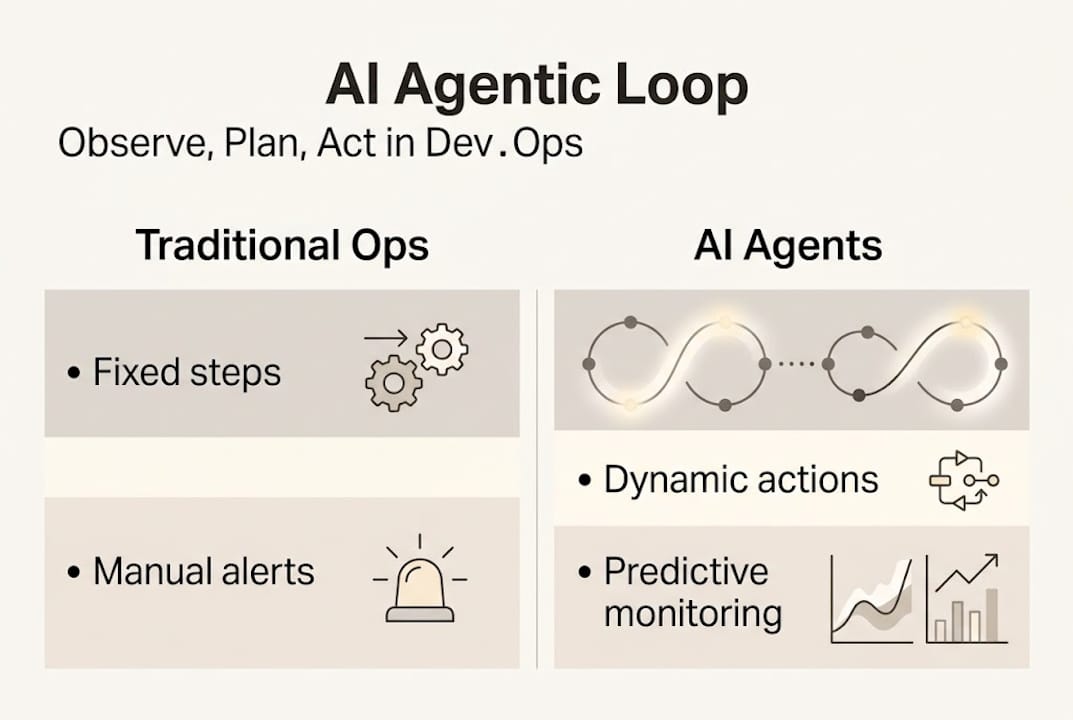
Here is a quick comparison to make this concrete:
| Dimension | Classic automation | AI agent |
|---|---|---|
| Action scope | Fixed, predefined steps | Dynamic, context-driven |
| Decision making | Rule-based | Reasoning-based (LLM-backed) |
| Loop autonomy | None | Observe-plan-act cycle |
| Adaptability | Low | High |
In practice, agents integrate with tools your team already uses: Kubernetes, Terraform, CloudWatch, PagerDuty, Datadog, and more via the Model Context Protocol (MCP). You can learn more about agent capabilities and pitfalls before committing to any architecture.
Key models you will encounter in the wild:
- 🤖 Single-agent loops: One agent handles observe-plan-act for a scoped task (e.g., autoscaling)
- 🔗 Multi-agent architectures: Specialized agents collaborate, with an orchestrator coordinating handoffs
- 👤 Human-in-the-loop: Critical actions require human approval before execution
"Agents succeed when governance is built in from day one, not bolted on after the fact." — Microsoft Azure DevOps team
The Argonix blog covers how these patterns play out across real enterprise deployments if you want to go deeper.
How AI agents optimize cloud operations
Once you understand what agents are, the next question is: what do they actually change in your cloud environment? The short answer is a lot, and the numbers back it up.
Agents enable predictive monitoring, automated autoscaling, and real-time cost control (FinOps). Empirically, AI-driven monitoring detects memory leaks and self-healing fixes before they cascade into outages. That means your on-call engineer is not the first line of defense anymore.

| Capability | Traditional telemetry | AI-driven approach |
|---|---|---|
| Anomaly detection | Threshold alerts | Predictive pattern recognition |
| Scaling decisions | Manual or rule-based | Context-aware autoscaling |
| Cost optimization | Periodic reviews | Continuous real-time FinOps |
| Self-healing | Human-initiated | Automated remediation |
The efficiency wins are measurable. Multi-agent systems achieve 96% RCA accuracy and a 73% auto-fix success rate in production environments. That is not a pilot result. That is a benchmark from real deployments.
Top three agent-driven efficiency wins your team can expect:
- ⚡ Faster detection: Anomalies caught in seconds, not minutes, before users notice
- 🔧 Automated remediation: Agents drain traffic, restart pods, or roll back deployments without a ticket
- 💰 Cost savings: Continuous rightsizing and idle resource cleanup reduce cloud bills without manual audits
Pro Tip: Start with AI-powered monitoring scoped to one service or cluster. Narrow scope means faster wins, lower risk, and cleaner data to justify broader rollout. Resist the urge to go wide immediately.
The path from reactive to proactive ops is well documented in AI-driven cloud monitoring and multi-cloud automation best practices if you want a tactical roadmap.
Boosting incident response with AI agents
Incident response is where AI agents deliver their most dramatic, measurable impact. When something breaks at scale, every minute of MTTR (Mean Time to Resolution) costs money and user trust.
Agents change the game by correlating alerts from multiple sources simultaneously, performing automated root cause analysis (RCA), and surfacing actionable mitigation steps before a human even opens a terminal. AI agents reduce MTTR by up to 75%, can diagnose incidents in as little as 4 minutes, and reduce alert noise by up to 91%.
📊 Before vs. after AI agent adoption:
| Metric | Before agents | After agents |
|---|---|---|
| Average MTTR | 2+ hours | Under 30 minutes |
| Alert noise | High volume, low signal | 91% reduction |
| RCA speed | 30 to 60 minutes | 4 minutes |
| On-call burden | High, frequent pages | Significantly reduced |
Real-world proof: WGU cut incident response time from 2 hours to 28 minutes after deploying AI agents. That is not a marginal improvement. That is a structural shift in how their ops team operates.
Here is how agent-powered incident response actually works, step by step:
- Alert ingestion: Agent collects signals from monitoring tools, logs, and traces simultaneously
- Correlation and triage: Agent identifies the probable root cause and severity in real time
- Automated mitigation: Agent executes approved remediation actions (restart, rollback, scale)
- Human escalation: If confidence is below threshold, agent pings the right engineer with full context
The AI incident response model is already proven. And if you want to understand how the broader shift is playing out across enterprise teams, AI transforming incident response is worth a read.
Benchmarks, pitfalls, and real-world lessons
The results are real, but so are the risks. Let's talk about both.
On the performance side, AI code review reduces PR cycle time by 40 to 60%, increases deployment frequency by 35%, and reduces change failure rate by 30 to 40%. Those are DORA metric improvements that directly affect your team's delivery velocity and reliability.
But here is the uncomfortable truth: agents scale broken practices. If your pipelines are fragile, your playbooks are unclear, or your access controls are loose, an agent will amplify those problems at machine speed. Hallucinations, protocol violations, and privilege escalations are real failure modes when governance is absent.
Top four ways to mitigate agent risks:
- 🛡️ Human-in-the-loop controls: Require human approval for high-impact actions (deployments, deletions)
- 📋 Policy-as-code: Define agent permissions and boundaries in version-controlled policy files
- 🔄 Staged rollout: Start with read-only agents, then expand to remediation actions incrementally
- 📈 Continuous evaluation: Track both DORA metrics and agent-specific KPIs (accuracy, false positive rate)
"Agents augment, not replace, teams. Prioritize foundations and governance before you prioritize speed."
Pro Tip: Always measure with both DORA metrics and agent-specific safety KPIs. Deployment frequency going up means nothing if your agent is also generating false positives that erode engineer trust.
For a deeper look at how mature teams structure this, check out why a dedicated DevOps platform matters, the top cloud DevOps trends shaping 2026, and how GitOps automation fits into a governed agent deployment model.
Our perspective: The real path to AI-powered DevOps
Here is what most DevOps leaders miss when they start evaluating AI agents: the technology is not the hard part. The hard part is organizational readiness.
Gartner predicts 70% of enterprises will use AI agents by 2029, but the elite teams we see succeeding are not the ones with the most advanced models. They are the ones with clear incident playbooks, policy-as-code boundaries, and a culture of auditable interventions.
Without that foundation, agents do not bring discipline to chaos. They accelerate it. We have seen teams deploy agents into environments where alert routing was already broken, and the result was faster noise, not faster resolution. 😱
The best enterprise deployments we know of use a hybrid model: a human orchestrator sets intent, agents execute and report back, and every intervention is logged and reviewable. That is not a limitation. That is the design.
Our hardest-won lesson? Start small. Scope your first agent to one function, one environment, one team. Measure rigorously. Treat agents as teammates under close watch, not autonomous replacements. When you earn trust through results, expand deliberately. That is the real path.
How Argonix accelerates DevOps with AI agents
If this article has you thinking about where to start, we built Argonix to answer exactly that question.
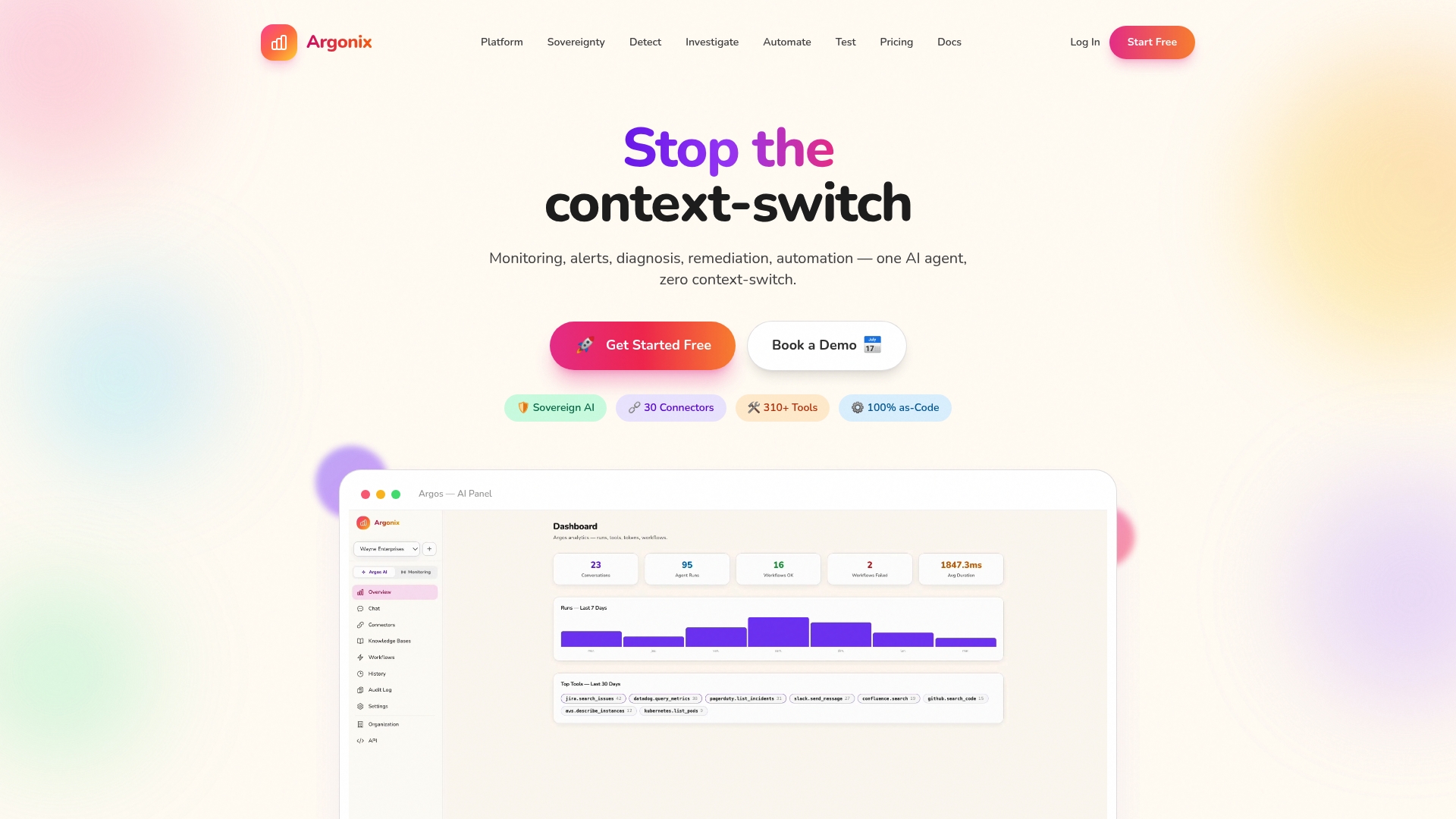
Argonix gives your team out-of-the-box AI agents for AI-driven incident response, infrastructure monitoring, and GitOps automation, all with enterprise-grade controls built in from day one. You can pilot AI-powered workflows in days, not months. Built-in best practices mean you are not starting from scratch on governance. And our staged rollout controls ensure your team stays in command at every step. No rogue agents. No surprise escalations. Just faster, smarter operations with the guardrails your organization actually needs.
Frequently asked questions
What is the difference between AI agents and traditional DevOps automation?
AI agents autonomously observe, decide, and act using real-time context and agentic loops, while traditional automation executes fixed, predefined scripts without any adaptive reasoning.
How do AI agents reduce mean time to resolution (MTTR) in DevOps incidents?
They automate alert correlation, perform rapid root cause analysis, and initiate corrective actions, with benchmarks showing MTTR reduced by up to 75% and issues diagnosed in as little as 4 minutes.
What are the main risks of deploying AI agents for DevOps?
Top risks include scaling broken automation, AI hallucinations, and security exposure from over-privileged access. Agents can hallucinate and break pipelines if governance and policy-as-code boundaries are not in place.
Which DevOps functions benefit most from AI agents today?
Incident response, cloud operations (monitoring and autoscaling), and code review show the highest gains. Agents excel in high-frequency operations like incident triage and smart test selection, where speed and accuracy matter most.