

TL;DR:
- Effective cloud security assurance requires explicit, architecture-driven controls that are continuously validated through comprehensive telemetry and evidence. Relying on assumptions or incomplete configurations leaves organizations vulnerable to silent drifts and unnoticed breaches across multi-cloud environments. Implementing a normalized, control plane–anchored assurance framework ensures ongoing protection, validation, and audit readiness at scale.
Picture this: your team runs workloads across AWS, Azure, and GCP. You've got firewalls up, IAM policies in place, and encryption enabled. You feel covered. Then a misconfiguration silently propagates across three accounts for six weeks before anyone notices. No alert fires. No audit flag triggers. Why? Because your team assumed assurance was there. It wasn't. Security assurance in cloud must be implemented as an explicit, architecture-driven control objective that is continuously validated, not inferred from network location or account ownership. This guide walks you through every step to get that right.
Table of Contents
- Understand the security assurance challenge in cloud environments 🔍
- Establish your cloud security assurance foundation: Baselines and shared responsibility 📋
- Implement continuous security assurance across clouds 🔄
- Normalize controls and validate assurance in multi-cloud operations 🎯
- Maintain, refine, and audit your security assurance posture 📊
- What most enterprises miss (and how to actually make security assurance work in cloud))
- Next steps: Operationalize assurance with automation and unified monitoring
- Frequently asked questions
Key Takeaways
| Point | Details |
|---|---|
| Control plane focus | Anchor assurance at the cloud control plane for enforcement, validation, and audit evidence. |
| Continuous verification | Implement telemetry and policy compliance checks on an ongoing basis, not as one-time tasks. |
| Policy normalization | Normalize policies and controls across all providers to close assurance gaps in multi-cloud environments. |
| Evolving maturity | Start with secure baselines and advance through regular reviews, monitoring, and evidence-driven improvement. |
| Unified audit evidence | Aggregate and correlate cross-cloud telemetry for strong, defensible assurance in audits and investigations. |
Understand the security assurance challenge in cloud environments 🔍
Let's define the problem clearly before we try to fix it.
Security assurance in an enterprise cloud context is the ongoing process of proving that your controls actually work, not just confirming that they exist. That distinction matters enormously. A policy that looks correct in a console and a policy that is enforced and validated are two completely different things.
Traditional on-premises security relied heavily on implicit trust. You trusted that traffic inside your network perimeter was safe. You trusted that account ownership meant control. In cloud environments, those assumptions collapse quickly.
| Dimension | Traditional (on-premises) | Cloud-native assurance |
|---|---|---|
| Trust model | Perimeter-based, implicit | Identity-based, explicit |
| Enforcement boundary | Network edge | Control plane |
| Validation method | Periodic audits | Continuous telemetry |
| Evidence source | Firewall logs, SIEMs | Cloud-native logs, policy engines |
| Drift detection | Manual checks | Automated posture monitoring |
| Shared responsibility | Fully internal | Provider and customer split |
The shift from perimeter to control plane is the hardest mental model to internalize. Most teams get it intellectually but don't operationalize it. The control plane is where API calls are authorized, where IAM decisions happen, where resource configurations are enforced. That's your real enforcement boundary now.
Here's what happens when teams assume assurance is already "covered":
- 🔴 They enable a service without checking if logging is actually streaming to their SIEM
- 🔴 They inherit a cloud account with legacy IAM roles and never audit them
- 🔴 They apply a security policy in one cloud but forget the equivalent configuration in another
- 🔴 They rely on compliance scan results without verifying the scan's coverage scope
- 🔴 They assume encryption is active because the setting was toggled on, without checking key rotation or scope
⚠️ Reality check: The majority of cloud breaches are not sophisticated zero-day attacks. They're the result of assumption-based assurance, where teams believe controls are working because they were once configured correctly.
This is the environment you're operating in. Let's build something better.
Establish your cloud security assurance foundation: Baselines and shared responsibility 📋
With the architectural intent clear, the next move is foundational. You need a baseline before you can monitor drift, enforce continuously, or produce audit evidence.
The Azure Well-Architected Framework security maturity model describes this progression clearly: start with a security baseline covering identity, encryption, and secure deployment processes, then mature toward hardened systems and continuous monitoring. Trying to skip baseline work and jump straight to advanced threat detection is one of the most common (and costly) mistakes we see.
Here's how to set up your baseline in multi-cloud environments:
- Enable MFA and enforce least privilege across all identity providers. This applies to human users and service accounts. Every cloud. No exceptions.
- Configure encryption at rest and in transit. Verify key management policies are active, and document which provider manages which keys under the shared model.
- Enable audit logging on all accounts and services. This includes CloudTrail in AWS, Diagnostic Settings in Azure, and Audit Logs in GCP. Confirm the logs are actually being exported and retained.
- Define and document your shared responsibility boundary. Map which controls the cloud provider owns versus which ones you own for every service category you use.
- Deploy a security baseline policy set. Use native tools like AWS Config Rules, Azure Policy, or GCP Organization Policies to enforce your baseline automatically.
- Validate each control with operational proof. Don't just enable a control. Confirm it works by testing it and capturing evidence.
That last step is where most enterprises stop short. Cloud security assurance in practice must explicitly account for the shared responsibility boundary and for operational proof of controls via telemetry and audit evidence. "We set it up" isn't evidence. "Here are the logs, policy states, and test results" is.
| Baseline control | AWS | Azure | GCP |
|---|---|---|---|
| Identity enforcement | IAM + Organizations SCPs | Entra ID + Conditional Access | IAM + Org Policies |
| Audit logging | CloudTrail | Azure Monitor / Diagnostic Settings | Cloud Audit Logs |
| Network policy | Security Groups + VPC Flow Logs | NSGs + Network Watcher | VPC Firewall Rules + Flow Logs |
| Encryption management | KMS | Azure Key Vault | Cloud KMS |
| Posture monitoring | AWS Security Hub | Microsoft Defender for Cloud | Security Command Center |
Pro Tip: Build a shared "controls registry" document that maps each baseline control to its implementation evidence, owner, and last validation date. This single artifact will save you enormous time when an auditor asks for proof that your encryption policy actually works.
Implement continuous security assurance across clouds 🔄
Baselines are static snapshots. Continuous assurance is what keeps them from going stale.
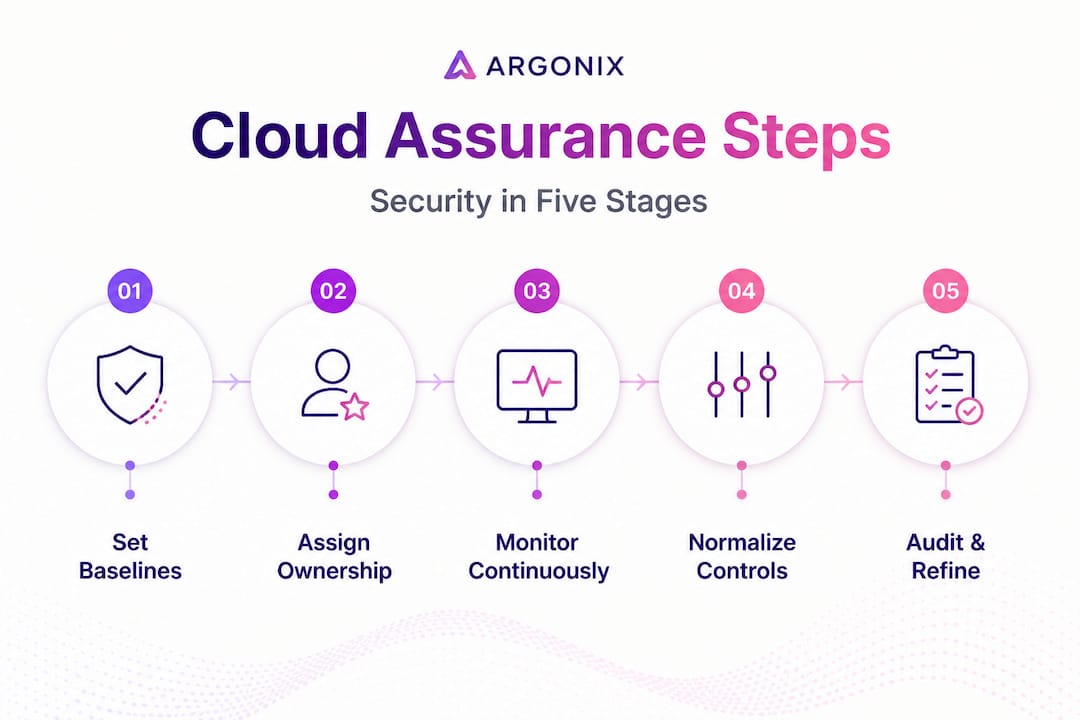
This is where the work gets operationally intense, especially in multi-cloud environments where each provider has different schema, different API surfaces, and different telemetry formats. As the Cloud Security Alliance highlights, security assurance in multi-cloud must include workload-integrity coverage (not just infrastructure posture), consistent policy enforcement, and unified evidence for continuous auditing.
Infrastructure posture tells you if your resources are configured correctly. Workload integrity tells you if what's running inside those resources is behaving as expected. You need both.
Steps to implement continuous assurance:
- Deploy unified multi-cloud monitoring. Aggregate telemetry from all cloud accounts into a single observability layer. Fragmented monitoring creates blind spots.
- Automate policy enforcement using provider-native tools and third-party orchestration. Don't rely on humans to check policy compliance manually.
- Instrument workloads for integrity signals. This means process monitoring, file integrity monitoring, and runtime behavior baselines for critical services.
- Collect cross-cloud audit evidence continuously. Every policy evaluation, every configuration change, every privilege escalation should generate an event that flows into your audit trail.
- Set up proactive monitoring with alerting thresholds for assurance failures, not just performance degradations. An expired certificate or an IAM role with wildcard permissions should fire an alert, just like a CPU spike.
Types of telemetry and audit evidence your continuous assurance program needs to capture:
- ✅ Cloud provider API logs (who called what, when, from where)
- ✅ Configuration state changes (resource modified, policy updated, permission granted)
- ✅ Identity and access events (logins, role assumptions, failed auth attempts)
- ✅ Network flow data (cross-account, cross-region, and external traffic)
- ✅ Workload runtime events (process execution, file access, container activity)
- ✅ Compliance evaluation results (policy pass/fail per resource, per account)
Use your cloud monitoring guide to structure the telemetry pipeline correctly from the start.
Pro Tip: The single biggest gap we see in continuous assurance programs is telemetry normalization. AWS calls it one thing, Azure calls it another, GCP calls it a third. If your detection rules are written against a single schema, you'll miss events from the other two clouds entirely. Normalize first.
Normalize controls and validate assurance in multi-cloud operations 🎯
Let's talk about the seams. The dangerous gaps between cloud providers.
Each CSP (cloud service provider) has its own terminology, schema, and control framework. When you write a policy for AWS and then try to replicate it in Azure, the translation is never perfect unless you're deliberate about it. This is what continuous control consistency requires: normalizing policies across CSPs, aggregating cross-cloud observability, and validating compliance posture per provider.

| Normalization approach | Effort | Coverage | Scalability |
|---|---|---|---|
| Manual mapping | High | Inconsistent | Poor |
| Automation (IaC/OPA) | Medium | High | Good |
| Third-party orchestration | Low to medium | Very high | Excellent |
| CSA CCM alignment | Medium | Vendor-neutral | Excellent |
Using the CSA Cloud Controls Matrix (CCM) as a normalization framework is underrated. It gives you a vendor-neutral control vocabulary, so your assurance program isn't tied to the taxonomy of whichever cloud you started with.
Essential log types and compliance events to aggregate across all clouds:
- 🔑 Authentication and authorization events
- 🔄 Configuration drift alerts
- 📁 Data access and movement logs
- 🚨 Policy evaluation failures
- 🔒 Certificate and key lifecycle events
- 🌐 Cross-account and cross-region API calls
- ⚙️ Infrastructure change events (provisioned, modified, deleted)
⚠️ Edge case warning: One of the most dangerous failure patterns we've seen is lateral movement that goes undetected because API call logs from Cloud A never correlated with authentication logs from Cloud B. An attacker compromises a service principal in Azure, then uses those credentials to call AWS APIs. If your logs aren't normalized and correlated in a unified pipeline, that cross-cloud chain of events looks like two unrelated, benign entries in two separate systems. This is how breaches expand before anyone notices. Aggregation plus correlation equals visibility.
Connect your proactive monitoring for cloud ops practices directly to your normalization pipeline. The two need to work as one system.
Maintain, refine, and audit your security assurance posture 📊
Execution is only half the story. What keeps a security assurance program effective long-term is the operational discipline to review, refine, and challenge it continuously.
The Azure Well-Architected security maturity model frames this as a progression through maturity stages: baseline, modeling, hardening, and continuous refinement. Most enterprise teams plateau at the baseline stage. They get MFA enabled, logging configured, and policies deployed, then shift focus elsewhere. That's when drift quietly accumulates.
Ongoing assurance maintenance steps:
- Run quarterly access reviews across all cloud accounts. Remove stale roles, unused service accounts, and over-permissioned identities.
- Schedule monthly policy drift checks. Compare your current resource configurations against your documented baseline.
- Conduct semi-annual control validation tests. Actually test that your controls fire correctly. Simulate a misconfiguration and verify your detection catches it.
- Update your shared responsibility documentation when you adopt new cloud services. Provider-managed controls change when you move from IaaS to PaaS to SaaS.
- Perform DevOps security best practices reviews as part of your CI/CD pipeline audits.
- Produce quarterly assurance reports for stakeholders with concrete evidence, not status summaries. Show policy states, drift incidents caught, remediation times, and audit log completeness rates.
Pro Tip: Resist the temptation to chase advanced detection capabilities before your foundational controls are solid. Deploying threat hunting tools on top of an incomplete log pipeline doesn't buy you safety. It buys you noise. Mature your baseline first, then layer on sophistication.
What most enterprises miss (and how to actually make security assurance work in cloud)
Here's the uncomfortable truth we've observed working with multi-cloud teams: most security assurance programs are built around a single cloud provider's mental model, then awkwardly stretched to cover the others. The result looks like assurance on paper but performs like hope in practice. 😅
Teams over-invest in cloud-specific tooling without ever solving the normalization problem. They'll have Defender for Cloud running perfectly in Azure while GCP has three orphaned projects with no monitoring attached. They'll enforce SCPs in AWS Organizations but have inconsistent tag policies that leave half their resources invisible to compliance checks.
The real failure point isn't tooling. It's the seams. Between schemas. Between team ownership boundaries. Between provider-specific audit evidence that never gets correlated into a unified picture.
What actually works, based on what we've seen from teams that get this right: treat telemetry normalization and policy translation as first-class engineering work, not an afterthought. Anchor your enforcement at the control plane. Build cross-cloud evidence pipelines before you build detection rules. And challenge every "we're covered" assumption with a single question: where's the proof?
Unified multi-cloud monitoring isn't a nice-to-have. It's the foundation that every other assurance capability depends on. Without it, you're validating pieces of a system you can't actually see as a whole.
Next steps: Operationalize assurance with automation and unified monitoring
Security assurance that lives in documents doesn't protect workloads. You need it running continuously, alerting intelligently, and remediating fast.
That's exactly what Argonix is built for. Our platform connects your multi-cloud environments through 40+ integrations, normalizes telemetry across providers, and runs AI-powered incident response workflows that catch assurance failures before they become breaches. With GitOps automation, your policy enforcement stays in sync with your infrastructure code automatically. And our infrastructure monitoring solutions give your ops team unified visibility across all cloud accounts in one place. Continuous assurance stops being a project and starts being how your cloud actually runs.
Frequently asked questions
What is the difference between security assurance and security controls in the cloud?
Security controls are the technical measures you set up, like IAM policies, encryption settings, and firewall rules. Security assurance is the ongoing validation that those controls are actually enforced and continuously validated, producing audit-ready evidence that proves they work.
How do you measure effective security assurance in a multi-cloud environment?
Measure it by unifying audit evidence across providers, enforcing policies consistently, and verifying both infrastructure posture and workload-integrity coverage for continuous auditing.
Why is policy normalization crucial for cloud security assurance?
Without normalization, consistent policy enforcement across CSPs breaks down because each provider uses different schemas, leading to coverage gaps and blind spots in your assurance posture.
What is the role of the control plane in cloud security assurance?
The control plane is the primary enforcement boundary where API calls, identity decisions, and resource configurations are governed. All assurance should be anchored at the control plane for continuous validation via telemetry.
How do you keep cloud security assurance effective as your cloud footprint expands?
Continuously review and normalize controls across new providers, refine your monitoring and audit evidence pipelines, and follow a security maturity progression that matures alongside your expanding infrastructure.
#CloudSecurity #MultiCloud #SecurityAssurance #DevSecOps #ZeroTrust #CloudOps #Argonix