

TL;DR:
- Early security integration in CI/CD reduces vulnerabilities and speeds up developers' feedback.
- Securing Kubernetes involves enforcing least privilege, network segmentation, and using automated policies.
- Centralized, AI-driven monitoring and incident response improve detection speed and effectiveness across multi-cloud.
Shipping fast is the goal. But every time you push a new microservice, spin up a cloud environment, or wire another CI/CD stage, your attack surface grows. The pressure on DevOps and security engineers to keep pace with both delivery velocity and threat agility has never been higher. Multi-cloud sprawl, container orchestration complexity, and IAM drift create gaps that attackers love to exploit. This article gives you practical, expert-validated security tips you can act on today, covering pipelines, Kubernetes, access management, and incident response across hybrid and multi-cloud setups.
Table of Contents
- Integrate security early in CI/CD pipelines: Shift-left essentials
- Strengthen Kubernetes: Secure configuration and access controls
- Address IAM misconfigurations and data exfiltration risks
- Monitor and respond to incidents in multi-cloud: Centralized and AI-driven approaches
- Our take: Why automation and AI are the real DevOps security unlock
- Accelerate your secure DevOps journey with Argonix
- Frequently asked questions
Key Takeaways
| Point | Details |
|---|---|
| Embed security early | Start security checks at the first stages of your CI/CD pipeline to reduce vulnerabilities before deployment. |
| Secure Kubernetes access | Use RBAC, network policies, and proper secrets management to lock down your container environments. |
| Prevent IAM breaches | Follow the OWASP Cloud Security Top 10 guidance—policy-as-code and regular reviews prevent most access failures. |
| Centralize and automate incident response | Leverage AI, logging platforms, and coordinated actions to quickly detect, correlate, and resolve multi-cloud incidents. |
| Prioritize adaptive automation | Automate security feedback loops and invest in AI-based solutions to stay ahead of evolving cloud threats. |
Integrate security early in CI/CD pipelines: Shift-left essentials
With the overall challenge established, let's start at the foundation: securing your pipelines from the very beginning.
Shift-left practices put security checks at the earliest stages of your pipeline, not as an afterthought at the gate. When a developer gets security feedback within seconds of committing code, they fix it immediately. When feedback arrives three sprint reviews later, it's a painful, expensive rollback. That speed of feedback is what changes developer behavior for the better.
Here's the security toolchain you should be running in every pipeline stage:
- 🔍 SAST (Static Analysis): Semgrep catches insecure code patterns before they ever reach a build.
- 📦 SCA (Software Composition Analysis): Snyk scans your dependencies for known CVEs automatically.
- 🏗️ IaC scanning: Checkov reviews your Terraform and Kubernetes manifests for misconfigurations before they hit production.
- 🔑 Secrets scanning: Gitleaks blocks hardcoded credentials from leaking into your repository history.
- 🐳 Container scanning: Trivy audits your container images for vulnerabilities at build time.
The two most common pipeline mistakes we see? Teams that delay scanning until a late stage, so developers have moved on mentally and context is lost. And teams that still have hardcoded credentials baked into their manifests, which is genuinely shocking in 2026 😱. Both problems are avoidable with the right automation in place.
Pro Tip: Wire security tool results directly into your pull request comments. Developers don't need to leave their workflow to see findings. That friction reduction means faster fixes and a culture that actually cares about security. Pair this with AI automation in DevOps to auto-triage low-severity noise so engineers focus on real risks.
Aligning your pipeline security posture with 2026 DevOps trends matters too. GitOps-driven deployments, for example, benefit enormously from GitOps automation that enforces policy gates before any merge lands in a production branch. Your DevOps communication tools should also surface security alerts in Slack or Teams channels so your team stays in the loop without hunting through dashboards.
Strengthen Kubernetes: Secure configuration and access controls
Once you've secured pipelines, container orchestration is the next critical layer.

Kubernetes gives your team incredible power. It also gives attackers plenty of surface area if you leave the defaults in place. RBAC, Pod Security Standards, Network Policies, secrets management, TLS, and audit logging form the baseline security configuration every cluster should have. Non-negotiable.
Here's what to lock down:
- 🔐 RBAC (Role-Based Access Control): Apply least privilege to every service account and user. If a pod doesn't need cluster-admin, it absolutely should not have it.
- 🛡️ Pod Security Standards (Restricted mode): Prevent privilege escalation, block host network access, and enforce read-only root filesystems where possible.
- 🌐 Network Policies: Segment traffic between namespaces. Microservices should only talk to the services they need, nothing more.
- 🗝️ Secrets management: Stop storing secrets as base64 in Kubernetes Secrets objects. Use HashiCorp Vault, AWS Secrets Manager, or Azure Key Vault instead. Base64 is not encryption.
- 📋 Audit logging: Enable and ship Kubernetes audit logs to your SIEM. They tell you exactly who did what and when, which is invaluable during an incident.
- 🔒 TLS everywhere: Encrypt pod-to-pod traffic using a service mesh like Istio or Linkerd.
Pro Tip: Use OPA Gatekeeper or Kyverno to enforce these policies automatically. Manual review doesn't scale. Policy-as-code means every new deployment is checked before it runs, not after something breaks. Review multi-cloud automation best practices to extend these patterns across cloud providers, and check out monitoring infrastructure security to keep your clusters visible in real time.
Address IAM misconfigurations and data exfiltration risks
With orchestration secured, the next battle is access management, often the root of major incidents.
If there's one statistic every cloud security engineer should have tattooed somewhere, it's this: IAM misconfigs drive 80% of cloud breaches. Overly permissive roles, unused access keys, and stale service accounts are low-hanging fruit for attackers. And in multi-cloud environments, managing IAM across AWS, Azure, and GCP simultaneously is genuinely complex.
The OWASP Cloud Security Top 10 calls out IAM misconfigurations, data exfiltration, configuration drift, and encryption failures as the dominant risk categories. Here's how to fight back:
- ✅ Policy-as-code: Define IAM policies in version-controlled code using tools like Open Policy Agent or AWS IAM Access Analyzer. Review and enforce them automatically.
- 🔄 Runtime protection: Tools like Prisma Cloud and Wiz monitor live environments for permission drift and alert you when a resource suddenly has broader access than intended.
- 📊 Access reviews: Run quarterly reviews at minimum. Revoke unused roles aggressively.
- 🔒 Encryption: Enforce encryption at rest and in transit everywhere. Treat unencrypted data as a misconfiguration, not just a best practice gap.
| Approach | Best for | Strength |
|---|---|---|
| Policy-as-code | Preventing misconfigs at deploy time | Catches issues before they reach production |
| Runtime protection | Detecting drift in live environments | Responds to real-time changes and anomalies |
| Access reviews | Removing stale permissions | Reduces standing access over time |
Check out multi-cloud automation tools that connect IAM monitoring across providers in one place. And if you're evaluating your current observability setup, cloud monitoring alternatives are worth a look to close visibility gaps.
Monitor and respond to incidents in multi-cloud: Centralized and AI-driven approaches
The last crucial step is ensuring you're continuously monitoring and prepared for incident response across hybrid cloud environments.
You can't defend what you can't see. In a multi-cloud environment, logs scatter across AWS CloudTrail, Azure Monitor, GCP Logging, your Kubernetes clusters, and a dozen SaaS tools. Without centralization, your response team is flying blind during an incident.
Centralizing logs with tools like Splunk and Datadog, combined with AI anomaly detection and alert correlation, dramatically compresses your mean time to detect (MTTD) and mean time to respond (MTTR). AI-driven detection spots patterns that no human analyst catches in real time, and correlated alerts cut through noise so your on-call engineer gets one actionable ticket, not 200 identical alerts.
Key actions for your monitoring and IR strategy:
- 📡 Centralize everything: Ship logs from all cloud providers, containers, and applications into a single SIEM or observability platform.
- 🤖 AI anomaly detection: Use ML-based detection to flag unusual API calls, lateral movement, or data access patterns automatically.
- 🔗 Alert correlation: Group related alerts into a single incident context to reduce fatigue and speed up triage.
- 🤝 Vendor coordination: The shared responsibility model means your cloud provider owns some security controls. Know exactly where your responsibility ends and theirs begins, and have escalation contacts ready.
| Tool | Strengths | Best use case |
|---|---|---|
| Splunk | Powerful query language, enterprise scale | SIEM, compliance, forensics |
| Datadog | Unified metrics, logs, traces | Full-stack observability and alerting |
| Elastic SIEM | Open source, flexible | Custom detection rules and log pipelines |
| PagerDuty | Alerting and on-call workflows | Incident escalation and coordination |
"Vendor coordination is essential for swift incident response in cloud environments. Without it, critical response actions stall at the boundary of shared responsibility."
Pair this with cloud trends in 2026 to understand where AI-driven security operations are heading next.
Our take: Why automation and AI are the real DevOps security unlock
Here's the uncomfortable truth: checklists don't protect you. Following a security framework religiously feels productive, but static policies can't keep up with the speed at which cloud environments change. A new misconfiguration can appear the moment someone runs a Terraform apply or updates a Helm chart. By the time a manual review catches it, damage may already be done.
What actually changes the game is treating security as an adaptive feedback loop, not a compliance exercise. AI automation for DevOps isn't a luxury anymore. Teams that invest in automating detection, response, and remediation consistently outperform those relying on periodic audits and manual gates. True security comes from rapid adaptation, not just policy creation.
Our honest recommendation: prioritize automating your first-response actions before writing another policy document. Close the loop between detection and remediation first, then layer in governance.
Accelerate your secure DevOps journey with Argonix
Ready to put these DevOps security strategies into practice? Argonix is built for exactly the environments you're managing: multi-cloud, container-heavy, fast-moving, and high-stakes.
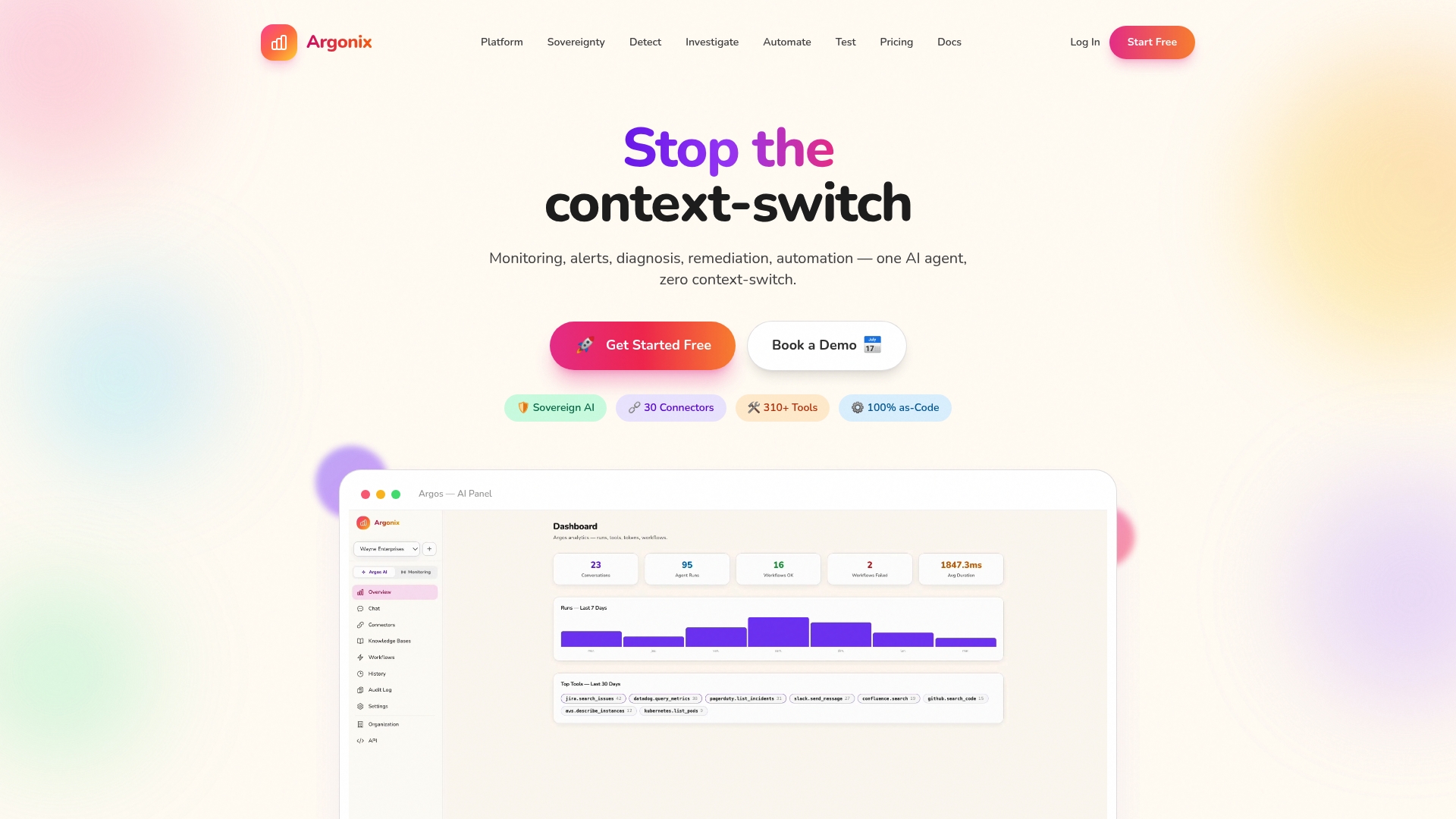
With AI incident response solutions, Argonix automatically correlates alerts, performs root cause analysis, and triggers remediation workflows across your entire stack. Its infrastructure monitoring tools give you unified visibility across cloud providers, Kubernetes clusters, and CI/CD pipelines in real time. Over 40 integrations mean you're not ripping out your current toolchain, you're adding intelligence on top of it. If your team is serious about moving from reactive firefighting to proactive, AI-driven security operations, Argonix is the platform built to get you there.
Frequently asked questions
What are shift-left security practices in DevOps?
Shift-left practices embed security tools directly into CI/CD pipelines, catching vulnerabilities early in the development cycle and dramatically reducing the cost and risk of fixing them later.
How can I prevent IAM misconfigurations in cloud environments?
Define permissions using policy-as-code and run regular access reviews to catch and revoke stale or overly permissive roles before they become a breach vector. IAM misconfigs are the leading driver of cloud security incidents, making this a top priority.
Which tools are best for centralized log management in multi-cloud?
Splunk and Datadog are leading choices for centralizing logs and enabling AI-based anomaly detection across multi-cloud and hybrid environments.
How should secrets be managed in Kubernetes?
Use dedicated secrets management tools like HashiCorp Vault or a cloud-native secrets manager instead of relying on base64 Kubernetes Secrets. Always enforce RBAC and enable audit logging to track access.
What is the shared responsibility model in cloud incident response?
The shared responsibility model splits security duties between your team and your cloud provider, so coordinating escalation contacts and response actions with vendors is essential for fast, effective incident resolution.
#DevOps #CloudSecurity #MultiCloud #DevSecOps #IncidentResponse #Kubernetes #Argonix