

TL;DR:
- Modern cloud automation orchestrates whole system lifecycles driven by policies and events.
- Proven automation practices dramatically improve reliability, reducing downtime and human error.
- Automation maturity involves continuous refinement, integrated observability, and human oversight.
82% of organizations now run multi-cloud environments and cite reliability as their top concern. Yet most teams still treat automation as a collection of bash scripts and cron jobs stitched together with hope. That gap between what automation is and what it can be costs real money: degraded uptime, slow incident recovery, and engineers buried in repetitive toil. This guide cuts through the noise. We'll define modern cloud automation clearly, map out its measurable benefits, walk through proven implementation practices, and confront the edge cases that catch even experienced teams off guard.
Table of Contents
- Defining cloud automation: core concepts and evolution
- Key benefits of cloud automation for multi-cloud operations
- Best practices for robust, reliable cloud automation
- Challenges and edge cases in automated cloud operations
- Why automation maturity—not just deployment—determines multi-cloud success
- Take the next step: operationalize cloud automation with confidence
- Frequently asked questions
Key Takeaways
| Point | Details |
|---|---|
| Strategy over scripts | Effective cloud automation requires holistic orchestration, not ad-hoc scripting solutions. |
| Reliability and scale | Automation boosts uptime and efficiency, especially in multi-region, multi-cloud environments. |
| Governance matters | Unified policy engines and human oversight are key for resilience and compliance. |
| Edge cases exist | Human-in-the-loop models and observability prevent automation failures at scale. |
Defining cloud automation: core concepts and evolution
Let's clear something up right away. Cloud automation is not just "run this script on a schedule." That mental model is 2015 thinking. In 2026, automation means orchestrating entire system lifecycles: provisioning, configuration, scaling, monitoring, incident response, and decommissioning, all driven by policy and event triggers rather than human clicks.
Modern cloud automation spans several layers:
- Provisioning automation: Spin up infrastructure on demand using templates and APIs
- Configuration management: Enforce consistent state across every node and service
- Scaling and scheduling: React to load signals automatically without manual intervention
- Incident response automation: Detect anomalies, trigger remediation, and restore services faster than any human could
- Compliance and policy enforcement: Apply guardrails continuously, not just at deployment time
The infrastructure automation conversation has fundamentally shifted. Where teams once automated individual tasks, leading organizations now automate workflows, entire sequences of dependent actions that span multiple systems and cloud providers.
📊 Cloud automation market at a glance
| Dimension | Current state (2026) |
|---|---|
| Market growth rate | 15.25% CAGR, driven by scale and reliability demands |
| Primary driver | Multi-cloud complexity and reliability requirements |
| Top use cases | IaC provisioning, auto-remediation, compliance enforcement |
| Adoption blocker | Fragmented tooling and skill gaps |
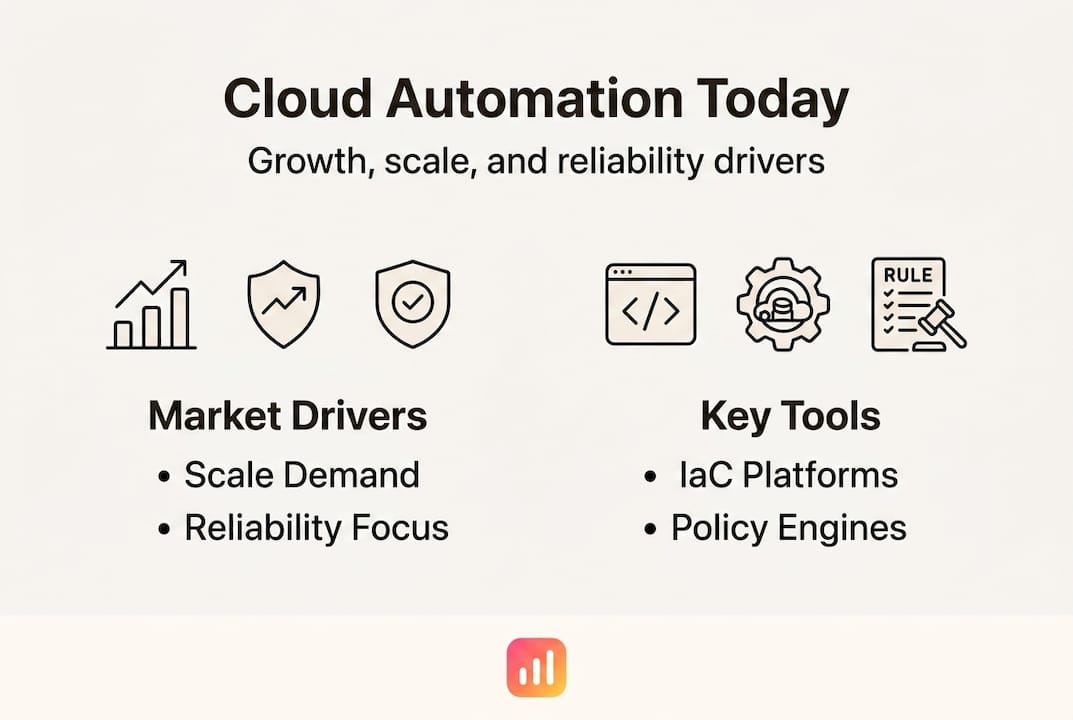
Infrastructure-as-code (IaC) is the backbone of serious automation programs. Tools like Terraform and Pulumi let your team define cloud resources as version-controlled code. That means every environment change is auditable, repeatable, and reviewable before it touches production. When you combine IaC with event-driven triggers and AI-assisted root cause analysis, you stop reacting to problems and start preventing them.
The shift also reflects a business reality. Manual operations simply do not scale with cloud complexity. When you're managing dozens of microservices across AWS, Azure, and GCP simultaneously, a human-centric ops model becomes a liability. Automation isn't a nice-to-have. It's the foundation that everything else runs on.
Pro Tip: Start your IaC journey by converting your most frequently modified infrastructure components first. These deliver the fastest ROI and build team confidence before tackling more complex stateful systems.
Following solid automation best practices from the start prevents the technical debt that comes from bolting automation on as an afterthought.
Key benefits of cloud automation for multi-cloud operations
With a clear definition in place, it's crucial to see how automation delivers measurable business value. Because the gains aren't marginal. They're transformational.

⚡ Automated vs. manual operations: a real comparison
| Metric | Manual operations | Automated operations |
|---|---|---|
| Mean time to detect (MTTD) | Minutes to hours | Seconds |
| Mean time to recover (MTTR) | 30 to 120 minutes | Under 5 minutes |
| Failures resolved autonomously | Less than 20% | 82% of failures |
| Availability ceiling | 99.9% (three nines) | 99.999% (five nines) |
| Human error rate | High (fatigue, context-switching) | Near zero for standard patterns |
Those numbers aren't theoretical. Multi-region setups with mature automation genuinely hit five-nine availability. That's roughly 5 minutes of downtime per year. Your on-call engineer no longer gets paged at 2 AM for a pod restart that should have triggered automatically.
"Automation boosts operational efficiency by 60% or more, but orchestration is needed for true reliability."
That quote captures something important. Efficiency alone isn't the goal. You can automate chaos efficiently. What matters is orchestrated automation, where your workflows are coordinated, observable, and governed by unified policies across every cloud.
Here's what that looks like in practice for a multi-cloud ops team:
- Unified policy enforcement: A single policy layer governs what's allowed across AWS, Azure, and GCP, so your security team isn't playing whack-a-mole across three control planes
- Cross-cloud observability: Every metric, log, and trace flows into one view, not three separate dashboards your SREs have to manually correlate
- Automated remediation chains: When a service degrades, the system detects it, identifies the cause, and triggers the fix, all before your first Slack alert fires
- Compliance-as-code: Governance policies run continuously, not just at quarterly audits
Improving multi-cloud IT efficiency requires more than deploying automation tools. It requires connecting them. Siloed automation is just complexity in disguise. A runbook that fixes AWS RDS issues means nothing if your Azure SQL failures still require manual intervention.
The good news? Teams that invest in connected IT automation connectors across their stack report dramatically faster incident resolution and significant reductions in toil. Your engineers stop being "human runbook executors" and start doing work that actually moves the product forward. 🎯
Best practices for robust, reliable cloud automation
Now that we've seen the benefits, successful automation depends on following proven practices. Because the gap between a working automation script and a production-grade automation program is enormous.
🔄 The four pillars of mature cloud automation
1. Standardize with IaC from day one
IaC standardization using Terraform or Pulumi, combined with unified policy engines like Open Policy Agent (OPA), is essential for handling edge cases at scale. When every resource is defined as code, you eliminate configuration drift, the slow divergence between what you think your environment looks like and what it actually is.
2. Build unified observability into every workflow
Automation without visibility is flying blind. Before you automate a remediation workflow, you need to know precisely what signals trigger it, what it changes, and how to verify success. Embed observability checkpoints at every stage of your automation chains.
3. Design for recovery, not just the happy path
Most teams automate the happy path. Service goes down? Restart it. That's fine for simple cases. But what happens when the restart fails? What if the restart causes a cascading failure in a dependent service? Every automation workflow needs explicit failure handling, retry logic, and escalation paths.
4. Treat security as a first-class automation citizen
Security guardrails should be baked into your automation, not layered on top. That means role-based access controls on your automation system itself, encrypted secrets management, and audit logs for every automated action.
📋 Pitfalls to actively avoid
- Ad-hoc script accumulation: Every "quick fix" script that lives outside your IaC repo is a future incident waiting to happen
- Fragmented tooling: Five different automation tools that don't talk to each other create more complexity than they resolve
- No human escalation path: Fully autonomous systems without human oversight create confidence until they fail catastrophically
- Skipping dry runs: Always test automation in staging with realistic production data volumes before enabling it live
⚠️ Statistic callout: Only 23% of organizations have fully integrated automation into service delivery. That means the majority are still running hybrid manual-automated processes that create dangerous gaps in coverage.
That 23% figure should be sobering. It means most teams have automation running, but not automation working as a coherent system. The remaining 77% face higher toil, slower recovery, and greater operational risk than they realize.
Pro Tip: Map your incident runbooks before you automate them. If you can't articulate the exact steps a human would take to resolve a specific failure, you can't reliably automate those steps. Documentation precedes automation, always.
Investing in a solid DevOps platform automation strategy also means choosing tools that compose well together. Platforms that integrate natively with your existing CI/CD, alerting, and ticketing systems dramatically reduce the coordination overhead your team absorbs daily.
Exploring multi-cloud tools that support cross-platform governance is equally important for teams managing heterogeneous environments.
Challenges and edge cases in automated cloud operations
Despite powerful gains, automation is not without pitfalls. Understanding edge cases is critical, especially as your environment grows from dozens to hundreds of services.
Here's the uncomfortable truth: automation that works beautifully at 20 services can fail spectacularly at 200. Scale introduces interaction effects that your original automation design never anticipated.
😱 Real failure modes we see repeatedly
- Automation storms: A cascading series of automated responses to a single anomaly, each triggering the next, until the remediation effort itself becomes the outage
- Configuration drift at scale: Even with IaC, manual changes sneak in during incidents and never get codified back. Over months, environments drift from their declared state
- Alert fatigue baked into automation: When your auto-remediation fires too aggressively on noise, it masks real signals and erodes SRE trust in the system
- Dependency blind spots: Automation that restarts Service A without knowing Service B depends on it in an undocumented way creates new failures while fixing the original one
- Partial failure states: An automation workflow completes 6 of 8 steps before failing. Now your system is in an inconsistent state that neither humans nor subsequent automation expected
"Narrow context in AI agents causes a 'complexity cliff'; human-in-loop models are preferred for recovery and adaptation."
That complexity cliff is real. AI-driven automation agents are excellent at handling well-defined, high-frequency failure patterns. They struggle when context is ambiguous or when failures combine in novel ways. The solution isn't less AI. It's better human-AI collaboration.
🛡️ Strategies for building resilient automation
- Implement circuit breakers: When an automation workflow fails repeatedly, it should pause and escalate rather than retry indefinitely
- Maintain a human escalation layer: For any incident that automation can't resolve within a defined threshold, route to a human immediately with full context
- Run regular chaos experiments: Deliberately inject failures into your automation to verify it handles edge cases correctly, not just in theory
- Track automation coverage metrics: Know exactly what percentage of your failure modes have automation coverage and what the gaps are
- Use agent-led decomposition: For complex incidents, break diagnosis into smaller scoped tasks that agents handle in parallel, with a human reviewing the synthesis
Reviewing AI agent pitfalls specific to IT operations helps teams avoid the overconfidence trap, the belief that because automation handles 82% of failures, the remaining 18% will somehow take care of themselves. They won't. And those 18% are usually the most severe incidents your team faces.
The most resilient automation programs we've seen treat "set and forget" as a red flag, not a success indicator. Persistent tracking, regular review, and intentional human touchpoints are what separate organizations with genuine reliability maturity from those with the appearance of it.
Why automation maturity—not just deployment—determines multi-cloud success
Here's the perspective we don't see shared enough: deploying automation is easy. Maturing it is hard. And the gap between those two states is where most reliability programs quietly break down.
We see it constantly. A team deploys Terraform, hooks up a few auto-remediation runbooks, and calls it done. Six months later, their environment has drifted, their runbooks cover only the failures they anticipated in January, and their on-call rotation is as exhausted as ever.
Automation maturity means continuously refining your policies, expanding your observability coverage, and maintaining intentional human touchpoints as your environment evolves. It means reviewing 2026 DevOps trends and asking whether your automation program reflects where infrastructure is going, not just where it was when you built it.
The organizations that consistently outperform on reliability treat automation as a living system. They have automation review cycles, not just deployment pipelines. They measure automation coverage as a key performance indicator, alongside availability and MTTR. And they recognize that shortcuts today, whether skipping IaC for a "quick" manual fix or removing a human escalation step to "speed things up", create compounding reliability risks that surface during your highest-stakes moments. Maturity isn't glamorous. But it's what keeps the lights on. 🔄
Take the next step: operationalize cloud automation with confidence
Equipped with new insights, here's how you can apply these automation best practices with Argonix.
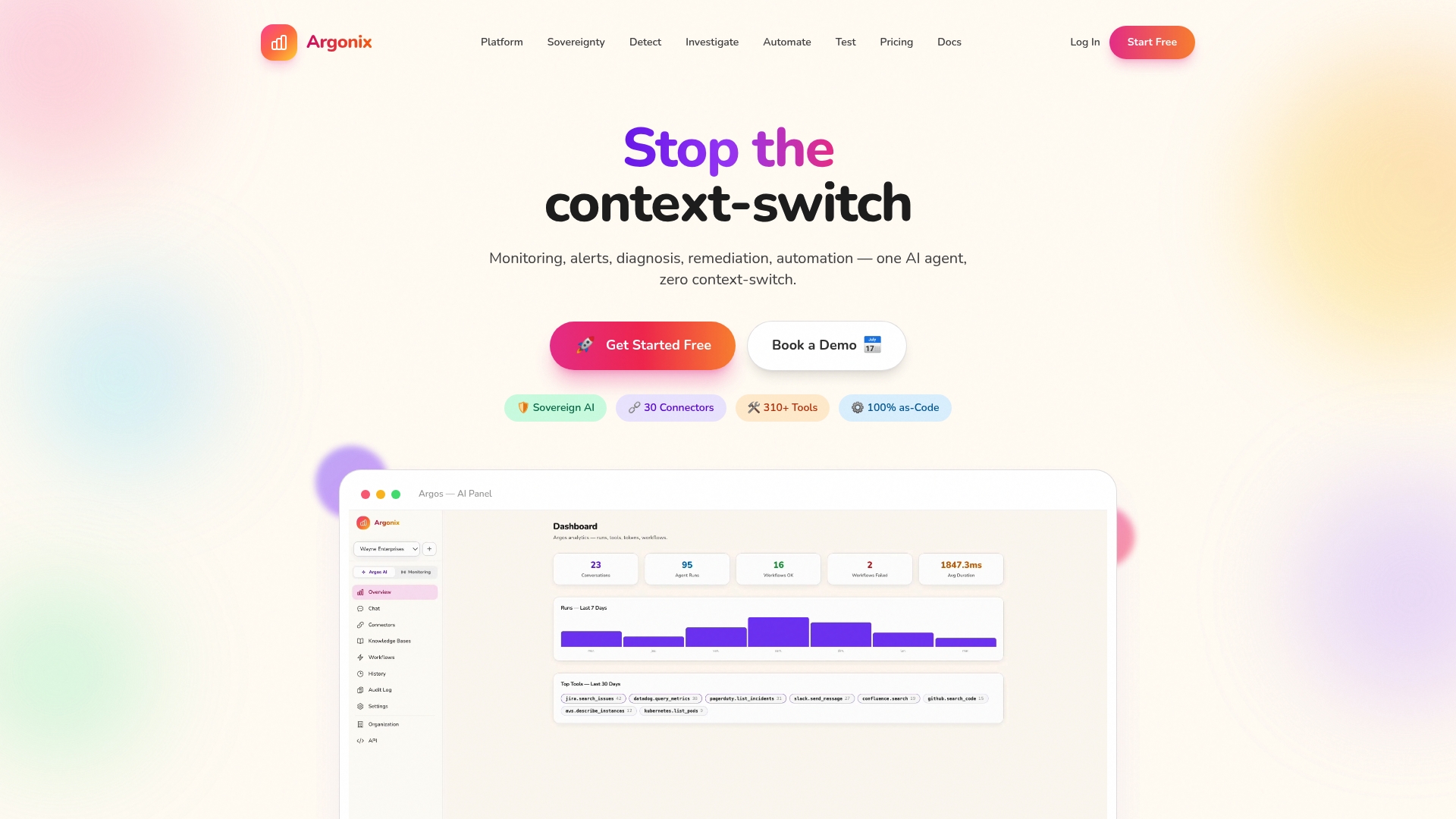
Argonix brings end-to-end cloud automation, observability, and intelligent incident response into a single platform. You get AI-driven root cause analysis, auto-remediation workflows, and over 40 integrations across cloud providers, CI/CD tools, and communication platforms. Whether you're building out GitOps automation pipelines, strengthening infrastructure monitoring across multi-cloud environments, or accelerating AI incident response, Argonix connects the dots your current toolchain leaves open. See it in action with a live walkthrough and discover what mature, unified automation actually feels like in practice.
Frequently asked questions
How does cloud automation improve reliability?
Automation enables faster recovery and higher uptime by autonomously resolving over 80% of failures, with multi-region setups reaching 99.999% availability, all while minimizing manual intervention.
What are common mistakes to avoid in automating cloud environments?
Relying on ad-hoc scripts, skipping unified policies, or ignoring human oversight leads to serious reliability and scalability risks. As noted in automation reliability research, treating automation as a holistic system rather than a collection of individual tools is what separates functional from fragile programs.
Why is human-in-the-loop automation important?
Keeping humans connected ensures systems recover and adapt when edge cases or AI limitations occur. Human-in-loop models consistently outperform fully autonomous approaches for complex recovery scenarios.
How can infrastructure-as-code (IaC) help with automation?
IaC tools standardize deployment processes and reduce misconfigurations at scale. IaC standardization using Terraform or Pulumi is widely recognized as a foundational pillar for managing multi-cloud automation complexity effectively.
#CloudAutomation #MultiCloud #DevOps #SRE #InfrastructureAutomation #CloudOps #IaC #Argonix