

TL;DR:
- Automation is essential for managing complexity, reliability, and cost in multi-cloud environments.
- Automated workflows significantly speed up deployments and reduce incident recovery times.
- A hybrid approach combining automation with human oversight ensures effective governance and risk management.
Managing a multi-cloud environment without solid automation is like trying to run a city with no traffic lights. Things work, until they spectacularly don't. IT leaders in 2026 face spiraling complexity: dozens of services across AWS, Azure, and GCP, each with its own config standards, compliance requirements, and deployment pipelines. The margin for error is razor thin. DevOps automation via CI/CD and IaC is now the clearest path to consistent deployments, lower costs, and measurable security improvements. This article breaks down the core benefits, honest trade-offs, and exactly what decision criteria matter most before you commit to an automation strategy.
Table of Contents
- Why automation is essential for multi-cloud DevOps
- Benefit 1: Faster, more reliable deployments 🚀
- Benefit 2: Lower operational costs and higher ROI 💰
- Benefit 3: Enhanced governance, reliability, and human factors 🔒
- A pragmatic take: What most automation guides won't tell you
- See measurable DevOps automation benefits with Argonix
- Frequently asked questions
Key Takeaways
| Point | Details |
|---|---|
| Faster deployments | Automation enables rapid, reliable releases in multi-cloud environments. |
| Reduced costs | DevOps automation slashes operational expenses and speeds up incident recovery. |
| Improved governance | Strong automation boosts compliance, auditability, and resilience. |
| Human expertise matters | Hybrid models that combine automation with human oversight deliver the safest outcomes. |
Why automation is essential for multi-cloud DevOps
Having set the context, let's unpack why automation is not just a nice-to-have, but essential in multi-cloud DevOps.
When you're running workloads across three or four cloud providers, configuration drift becomes your biggest enemy. One engineer manually tweaks a security group in AWS. Another adjusts a firewall rule in GCP. Within weeks, your environments are out of sync and your compliance posture looks like Swiss cheese 😱. That's not a hypothetical. It's Tuesday for most ops teams without strong automation in place.
Following multi-cloud automation best practices means building guardrails that catch these issues before they become outages. The core criteria every IT executive should evaluate when choosing an automation approach are:
- Scalability: Does it handle workloads growing 10x without manual re-tuning?
- Reliability: Are deployments repeatable and predictable across every cloud?
- Auditability: Can you trace every change back to its source for compliance?
- Speed: Does it dramatically reduce time-to-deploy and time-to-recover?
Those four pillars aren't aspirational. They're the baseline for any automation stack worth investing in.
The good news? The evidence is clear. DevOps automation via CI/CD and IaC measurably reduces deployment times and lowers operational costs in complex multi-cloud setups. Organizations that automate their pipelines don't just move faster. They also make fewer mistakes and spend less on firefighting.
Tracking DevOps trends for 2026 shows that IaC adoption and AI-assisted pipelines are accelerating fast. Teams that delay automation are falling further behind each quarter.
💡 Pro Tip: Start automation with high-churn, low-differentiation workflows first. Think environment provisioning, dependency updates, and standard deployments. You'll see fast wins without touching mission-critical logic right away.
The stakes are real. Outages in multi-cloud environments cost organizations an average of tens of thousands of dollars per hour. Automation is how you change that equation.
Benefit 1: Faster, more reliable deployments 🚀
With the essentials in mind, let's zoom in on the speed and reliability gain, universally the headline benefit of DevOps automation.

Manual deployments are slow and fragile. Your engineers are copy-pasting steps from runbooks, hoping nothing changed since the last time. An automated pipeline runs the same steps every single time, in the same order, across every environment. What used to take hours or days now takes minutes.
But speed alone isn't the story. Reliability is. DevOps automation via CI/CD and IaC dramatically optimizes deployment latency and incident recovery, enabling frequent and reliable releases that your business can actually count on.
Here's what that looks like in practice:
- Automated rollback triggers the moment a health check fails
- Canary deployments reduce blast radius for risky changes
- Automated smoke tests validate every release before traffic shifts
- Faster feedback cycles mean your team hears about issues in seconds, not hours
"The shift to automated pipelines didn't just speed up our releases. It fundamentally changed our incident profile. We went from reactive firefighting to proactive validation."
Let's look at how the numbers compare:
| Metric | Manual process | Automated process |
|---|---|---|
| Deployment time | 4 to 8 hours | 10 to 20 minutes |
| Failure rate | 15 to 25% | Under 5% |
| MTTR (Mean time to recover) | 45 to 120 minutes | 5 to 12 minutes |
| Rollback time | 30 to 90 minutes | Under 5 minutes |
Those aren't theoretical numbers. They represent what teams achieve when they invest in automation tool connectors that tie together their CI/CD pipelines, monitoring tools, and communication platforms.
The compounding effect matters too. Faster deployments mean faster iteration. Faster iteration means you ship features that customers actually need, sooner. That's a competitive moat, not just an ops efficiency gain.
Benefit 2: Lower operational costs and higher ROI 💰
Speed is vital, but cost savings and ROI often drive executive buy-in, so let's examine the numbers.
Let's talk about what manual operations actually cost your organization. You're paying engineers to run repetitive tasks. You're paying for downtime during slow incident response. You're paying for rework when deployments fail and configs drift. All of that adds up fast.
Empirical benchmarks on DevOps automation show 192% ROI, 69% fewer incidents, and MTTR dropping from 45 to 120 minutes down to just 5 to 12 minutes. That last number deserves a moment. Incident recovery that's over 6,500% faster doesn't just save money. It protects revenue and customer trust.
Here's a before-and-after snapshot:
| KPI | Before automation | After automation |
|---|---|---|
| Monthly incident count | 45 to 60 | 14 to 19 |
| Avg. MTTR | 75 minutes | 8 minutes |
| Monthly downtime hours | 56 hours | 8 hours |
| OpEx on manual ops tasks | High | Reduced 40 to 60% |
Want to quantify ROI in your own context? Here's a practical three-step approach:
- Baseline your current costs: Track engineer hours on repetitive ops tasks, monthly incident counts, and average downtime cost per hour.
- Project automation impact: Apply industry benchmarks (or pilot data) to estimate reductions in incidents, MTTR, and manual labor hours.
- Calculate net savings: Subtract automation platform costs and implementation time from your projected savings over 12 months.
Learning from AI automation efficiency data shows that AI-augmented workflows drive the biggest ROI gains because they reduce human time spent on tasks that don't need human judgment.
Platforms that boost IT efficiency through unified monitoring and automated workflows turn telemetry data into direct cost savings.
💡 Pro Tip: Keep your automation telemetry visible to leadership. A live dashboard showing MTTR reductions and incident counts is the best ongoing proof of ROI you can give your CFO.
Benefit 3: Enhanced governance, reliability, and human factors 🔒
Beyond performance and cost, let's address the balance between automation benefits and the realities of human expert oversight.
AI-driven cloud monitoring and policy enforcement make governance dramatically easier. Every infrastructure change goes through code review. Every deployment generates an audit trail. Policy violations get flagged before they reach production.
Here's what strong automation means for governance:
- Full traceability: Every config change is versioned and attributed in Git
- Automated compliance checks: Policies run at pipeline time, not audit time
- Faster remediation: Policy violations trigger automated fix workflows
- Reduced risk surface: Fewer manual touchpoints mean fewer human errors
But here's the part that often gets glossed over. Not everything should be automated. Some decisions genuinely need a human in the loop.
"The most dangerous assumption in automation is that if a workflow runs without errors, it ran correctly. Business logic failures don't always throw exceptions."
The reality is that reconciliation loops fail in complex dependencies, and hybrid oversight is essential when environments have intricate service interdependencies. Automation handles the predictable. Humans handle the ambiguous.
Hybrid QA value is especially critical for mission-critical paths where edge case failures can cascade across services. An automated pipeline won't catch a business logic error that technically deploys cleanly but breaks downstream user flows.
The DevOps automation pitfalls to avoid: over-automating governance sign-off, removing human review from high-stakes deployments, and trusting reconciliation loops in environments with complex dependencies.
A pragmatic take: What most automation guides won't tell you
We've covered the evidence and benchmarks. Now here's the candid perspective that matters for real-world leaders.
Most automation guides sell you on the dream: fully automated pipelines, zero toil, autonomous ops. We've seen what happens when teams chase that dream without guardrails. Things break in ways that take days to diagnose because the automation masked the signals.
The control paradox is real. The more you automate, the less visibility you have into what's actually happening, unless your telemetry is excellent. Contrasting views on automation warn clearly against over-reliance without robust telemetry and oversight. We agree completely.
Here's what we tell every ops leader we work with: automate aggressively, but keep humans anchored in three places. First, business logic changes. Second, edge-case incident response. Third, compliance sign-off on high-risk changes.
Comparing GitOps vs. traditional ops shows that GitOps wins on auditability and consistency, but teams that abandon traditional review gates entirely often regret it during a complex rollback scenario.
Hybrid architectures are the safest path for business continuity. Automate everything repeatable. Keep humans close to everything consequential. That's not a weakness in your automation strategy. It's the maturity of it.
See measurable DevOps automation benefits with Argonix
Having understood both benefits and pitfalls, here's how you can take next steps with proven automation solutions.
Argonix is built for exactly this challenge. We give your ops team a platform that connects AI-driven automation with real human oversight, so you get the speed and cost benefits without the blind spots. From infrastructure monitoring that surfaces issues before they become incidents, to a GitOps automation platform that enforces policy at every deployment, to AI incident response that cuts MTTR to single-digit minutes, we've built the connectors and workflows your team needs.
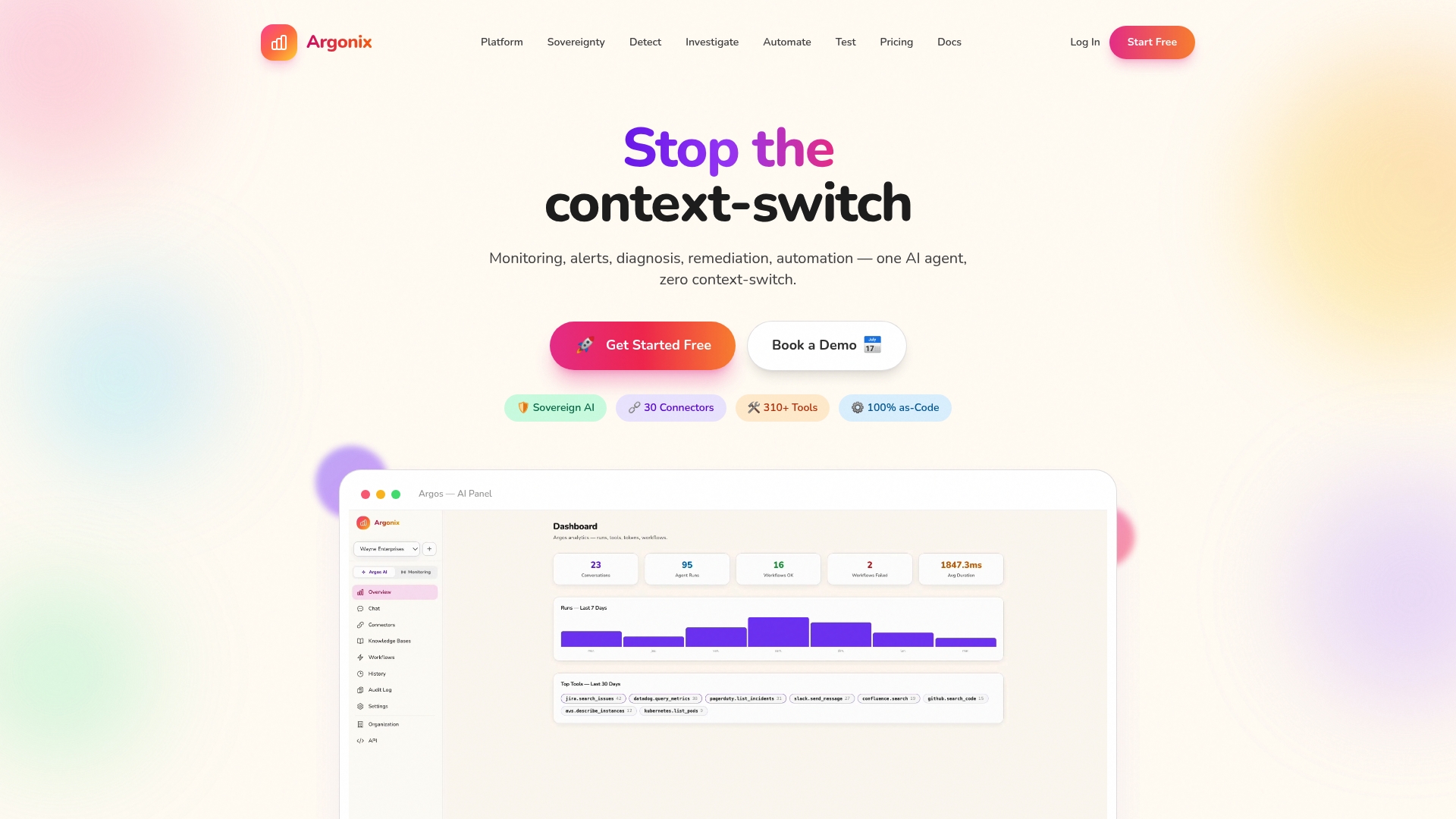
Ready to see what 192% ROI and 69% fewer incidents looks like in your environment? Book a demo with us. We'll show you exactly how Argonix maps to your current stack and where the fastest wins are hiding.
Frequently asked questions
What is the biggest benefit of DevOps automation in multi-cloud environments?
The most impactful benefit is dramatically reducing deployment times and boosting reliability while cutting operational costs. DevOps automation via CI/CD and IaC shows deployment latency and incident recovery optimized significantly through automation, enabling releases your business can depend on.
Does automation eliminate the need for human oversight in IT ops?
No. Best practice combines automation with human expertise, especially for complex, edge-case scenarios. Expert nuance: automation complements humans confirms that AI misses edge cases and business logic issues, making hybrid QA essential.
How do we measure ROI from DevOps automation?
Track reductions in downtime, MTTR, incident counts, and cost savings compared to your pre-automation baseline. Empirical benchmarks on DevOps automation document 192% ROI, 69% fewer incidents, and over 6,500% faster recovery as real-world reference points.
What are the risks of over-automating DevOps workflows?
Over-reliance without strong telemetry and verification can produce silent failures in complex scenarios. Reconciliation loops fail in complex dependencies, making independent verification a non-negotiable part of any mature automation strategy.
#DevOps #MultiCloud #CloudAutomation #DevOpsAutomation #SRE #CloudOps