

TL;DR:
- Cloud infrastructure in 2026 is an intelligent system integrating compute, storage, networking, and AI automation.
- AI-driven automation enables predictive scaling, incident response, and self-healing environments.
- Hybrid, multicloud, and neocloud models are preferred for resilience, compliance, and AI workload optimization.
Most enterprises think moving to the cloud means swapping physical servers for virtual ones. That's the misconception that quietly derails millions in IT budgets. Real cloud infrastructure in 2026 is a living, intelligent system built around compute, storage, networking, and AI-driven automation working together. Cloud-native platforms deliver 65% faster queries, 55% better integration, and 39% lower TCO versus on-premises setups. If your team still thinks of the cloud as just a hosting upgrade, you're leaving serious operational leverage on the table.
Table of Contents
- Core components of cloud infrastructure explained
- How cloud infrastructure powers operational efficiency
- AI-driven automation: The game changer in 2026 cloud infrastructure
- Hybrid, multicloud, and neoclouds: Strategies for resilience and sovereignty
- Why most enterprises still underestimate the complexity of cloud transformation
- Take cloud automation further with Argonix solutions
- Frequently asked questions
Key Takeaways
| Point | Details |
|---|---|
| Cloud infrastructure redefined | It means more than moving servers—AI-driven automation powers today’s cloud. |
| Measurable efficiency gains | Cloud-native architectures deliver faster queries, lower costs, and greater integration for enterprises. |
| AI drives future innovation | By 2026, half of cloud compute will be for AI, reshaping IT operations and automation. |
| Hybrid and neocloud models | Organizations are turning to hybrid, multicloud, and neoclouds for resilience and compliance. |
Core components of cloud infrastructure explained
Cloud infrastructure isn't a single thing. It's a stack of interconnected resources and services that your IT team provisions, manages, and scales on demand. Understanding each layer helps you make smarter decisions before you commit to a model.
At its core, cloud infrastructure includes:
- Compute: Virtual machines, containers, and serverless functions that run your workloads
- Storage: Object, block, and file storage options that scale without physical limits
- Networking: Virtual private clouds, load balancers, and content delivery networks
- Management layer: Orchestration tools, APIs, and automation platforms that tie everything together
From there, you choose your deployment model:
- Public cloud: Resources shared across tenants (AWS, Azure, GCP)
- Private cloud: Dedicated infrastructure, on-prem or hosted, for control and compliance
- Hybrid cloud: A mix of public and private, connected for workload flexibility
- Multicloud: Using multiple public cloud providers to avoid lock-in and optimize cost
And then there's the service model layer:
| Service model | What you manage | Best for |
|---|---|---|
| IaaS | OS, runtime, apps | Max control, custom workloads |
| PaaS | Apps and data only | Dev teams, faster deployment |
| SaaS | Nothing (just use it) | End-user productivity tools |
Enterprise outcomes shift dramatically depending on which combination you pick. Cloud platforms offer enhanced data integration and performance that legacy setups simply can't match at scale. Pairing the right model with solid infrastructure automation basics is what separates teams that thrive from teams that just survive.
Pro Tip: Don't pick a cloud model based on what's trendy. Map your compliance requirements, latency needs, and team skill sets first, then choose the model that fits. A hybrid approach often wins for regulated industries.
How cloud infrastructure powers operational efficiency
Now that you know the core components, let's see how cloud infrastructure delivers measurable improvements for enterprise operations. The numbers are hard to ignore.
Cloud-native architectures reduce total cost of ownership and boost integration by 55% over legacy systems. That's not just a cost story. It's a speed and agility story too.
"Cloud-native data warehouses deliver 65% faster query times, 39% lower TCO, and 55% better data integration compared to on-premises infrastructure." — Enterprise benchmark research, 2025
Here's how those gains translate to real operational workflows:
- Provision in minutes, not weeks: Spin up environments on demand without waiting for hardware procurement
- Scale automatically: Auto-scaling groups respond to traffic spikes without human intervention
- Integrate faster: Pre-built connectors and APIs reduce integration timelines dramatically
- Monitor in real time: Cloud-native observability tools surface issues before they become outages
- Recover faster: Automated failover and backup restore SLAs that on-prem setups can't match
On-premises vs. cloud: Key operational KPIs
| KPI | On-premises | Cloud-native |
|---|---|---|
| Query performance | Baseline | Up to 65% faster |
| Integration speed | Slow, manual | 55% improvement |
| Total cost of ownership | High capex | 39% lower |
| Deployment time | Weeks | Hours or minutes |
| Scalability | Limited by hardware | Near-unlimited |
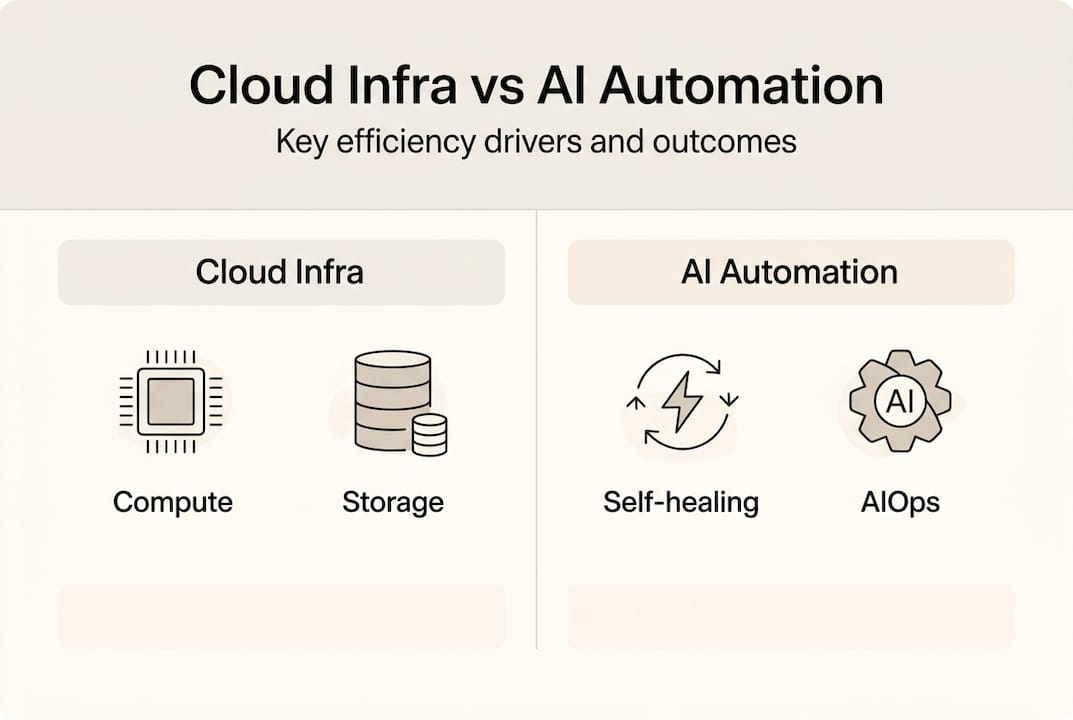
The efficiency case is clear. But efficiency without control creates new risks. That's why pairing cloud infrastructure with the right automation connectors for cloud environments is critical for your ops team to stay ahead.
AI-driven automation: The game changer in 2026 cloud infrastructure
Efficiency leaps are just the beginning. AI and automation are pushing cloud infrastructure into entirely new territory, and your competitors are already moving.
AIOps (AI for IT Operations) applies machine learning and AI to automate and optimize IT processes. Think predictive alerting, automated root cause analysis, and self-healing systems that fix issues before your on-call engineer even gets paged. 😱
By 2026, up to 50% of cloud compute will run AI workloads. That's a seismic shift in how cloud resources get allocated and managed.
Top AI-driven automation use cases for enterprise IT teams:
- Predictive scaling: AI models forecast demand and pre-provision resources before load spikes hit
- Automated incident response: AI detects anomalies, correlates signals, and triggers remediation workflows automatically
- Root cause analysis: Instead of manually combing through logs, AI surfaces the likely cause in seconds
- Drift detection: Continuous monitoring flags when your infrastructure diverges from its desired state
- Cost optimization: AI identifies idle resources and rightsizing opportunities across your cloud spend
Self-healing environments are no longer science fiction. Modern platforms use AI-driven monitoring to detect degraded services and trigger auto-remediation without human input. Your SRE team stops firefighting and starts engineering.

Understanding AI agents in IT ops is now a baseline skill for enterprise architects. These agents don't just observe. They act. They open tickets, run playbooks, and ping the right team in Slack, all without a human in the loop.
For teams building out their strategy, DevOps automation efficiency and 2026 DevOps cloud trends are worth a deep read to understand where the industry is heading.
Pro Tip: Start AI automation with a single, high-frequency pain point, like noisy alert triage. Prove ROI there, then expand. Trying to automate everything at once is how you end up with a more complex mess than you started with.
Hybrid, multicloud, and neoclouds: Strategies for resilience and sovereignty
AI demands aren't the only driver. Choosing the right cloud model now depends on resilience and compliance as much as efficiency. The landscape has gotten more nuanced, and that's actually good news for enterprises with complex requirements.
Here's a quick breakdown of the models gaining traction:
- Hybrid cloud: Combines on-prem and public cloud, ideal for regulated workloads that can't leave your data center
- Multicloud: Distributes workloads across AWS, Azure, GCP, or others to avoid vendor lock-in and optimize for price and performance
- Neocloud: Next-gen providers (often regional or specialized) built specifically for AI workloads and data sovereignty requirements
- Private AI cloud: Dedicated infrastructure for running AI models internally, keeping sensitive training data off hyperscaler networks
📊 Stat callout: 25% of organizations will express dissatisfaction with traditional cloud services by 2028, accelerating the shift to hybrid and neocloud models. Cost overruns, unexpected egress fees, and compliance gaps are the top drivers of that frustration.
Regulatory pressure is real. GDPR, HIPAA, and emerging AI governance frameworks are forcing enterprises to think carefully about where data lives and who can access it. Private AI and neoclouds are rising for enterprises prioritizing sovereignty, especially as hyperscalers face scrutiny over data practices.
For your ops team, managing multiple environments adds complexity. That's why unified multicloud monitoring and solid automation for multicloud ops aren't optional extras. They're operational necessities.
The smartest enterprises treat cloud model selection as an ongoing strategic decision, not a one-time migration project. Review your model annually as workloads, regulations, and AI capabilities evolve.
Why most enterprises still underestimate the complexity of cloud transformation
Here's an uncomfortable truth: most cloud migrations fail not because of technology, but because of strategy. We see it constantly. A team picks a cloud provider, lifts and shifts their workloads, and then wonders why their costs went up and their ops team is more stressed than before.
The mistake is treating cloud transformation as a technical problem. It's a strategic shift. Change management, governance frameworks, and new security postures matter just as much as which Kubernetes distribution you pick.
AI and automation make this harder, not easier, if you rush in. Automated systems amplify both good decisions and bad ones. An unchecked auto-remediation workflow can cascade failures faster than any human could. DevOps infrastructure trends point clearly toward teams that invest in governance and observability outperforming those that chase tooling.
Revisit your cloud objectives every quarter. The platforms, the models, and the AI capabilities are all moving fast. Your strategy needs to keep pace.
Take cloud automation further with Argonix solutions
Ready to transform IT operations and tap into the competitive edge of AI-powered cloud infrastructure? We built Argonix specifically for teams managing complex, multi-cloud, and microservices environments who are tired of stitching together point solutions.
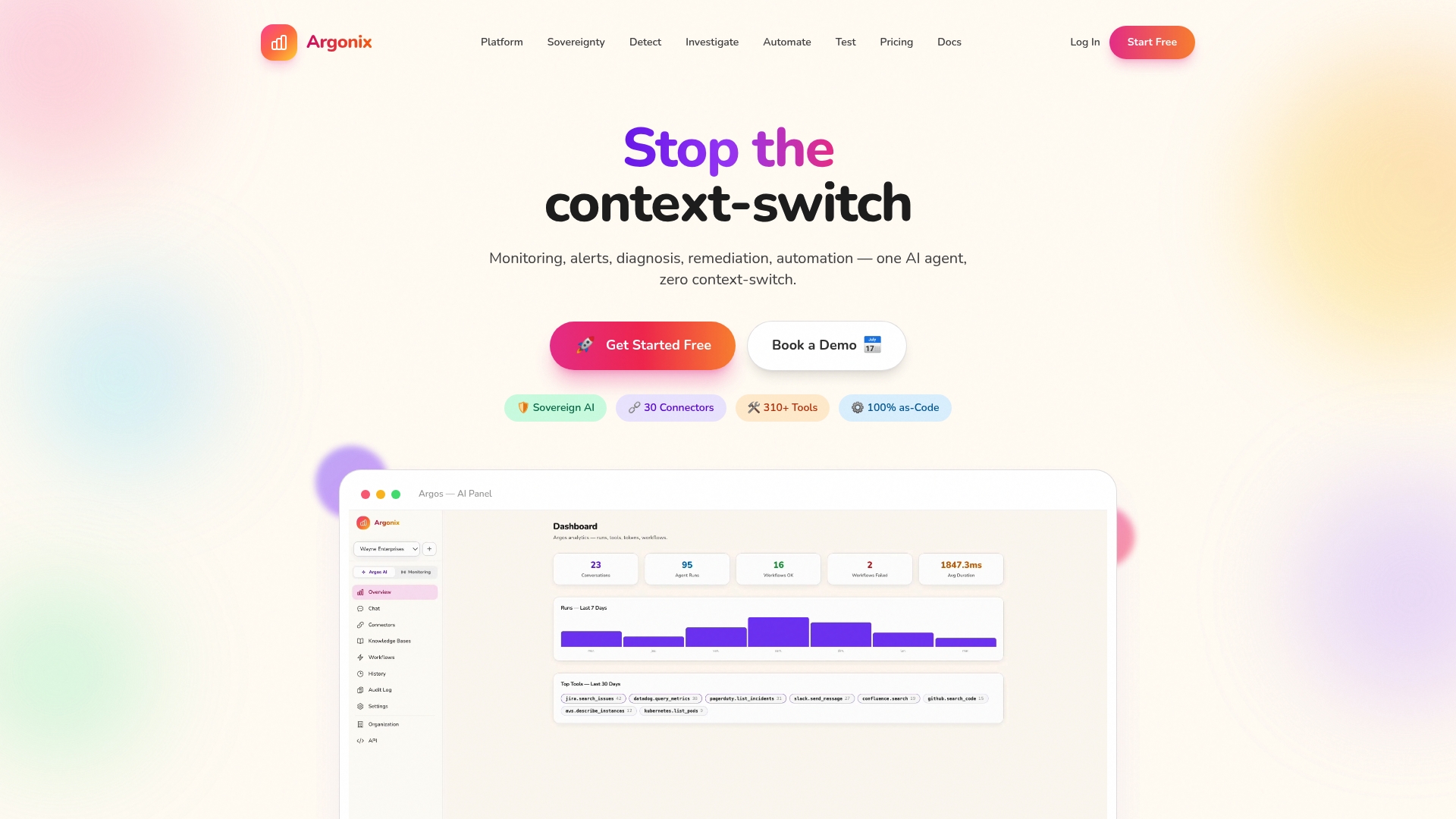
Argonix brings AI incident response, real-time infrastructure monitoring, and GitOps automation into a single platform with over 40 connectors across cloud providers, observability tools, CI/CD pipelines, and communication platforms. From automated root cause analysis to Terraform and Kubernetes-native IaC management, Argonix gives your ops team the intelligence and automation they need to stop firefighting and start building. Explore what's possible at argonix.io.
Frequently asked questions
What is the difference between cloud infrastructure and on-premises infrastructure?
Cloud infrastructure is delivered via the internet using scalable resources from third-party or private providers, while on-premises setups require in-house physical hardware and manual management. Cloud-native platforms outperform on-premises in speed, cost, and integration across every major benchmark.
How does AI impact enterprise cloud infrastructure in 2026?
In 2026, AI is central for automating, predicting, and optimizing IT operations, with 50% of cloud compute running AI-powered processes. This means less manual intervention and faster, smarter incident response for your team.
Why are multicloud and hybrid cloud models popular now?
Organizations prefer multicloud and hybrid strategies to boost resilience, stay compliant, and control costs, especially as dissatisfaction with traditional cloud models grows toward 25% of enterprises by 2028.
What are neoclouds and why do they matter?
Neoclouds are next-gen cloud providers focused on AI and sovereignty that help enterprises keep control over data and workloads while leveraging advanced automation. Private AI and neocloud models are rising as enterprises push back against hyperscaler data practices.
#CloudInfrastructure #AIOps #CloudAutomation #DevOps #Argonix